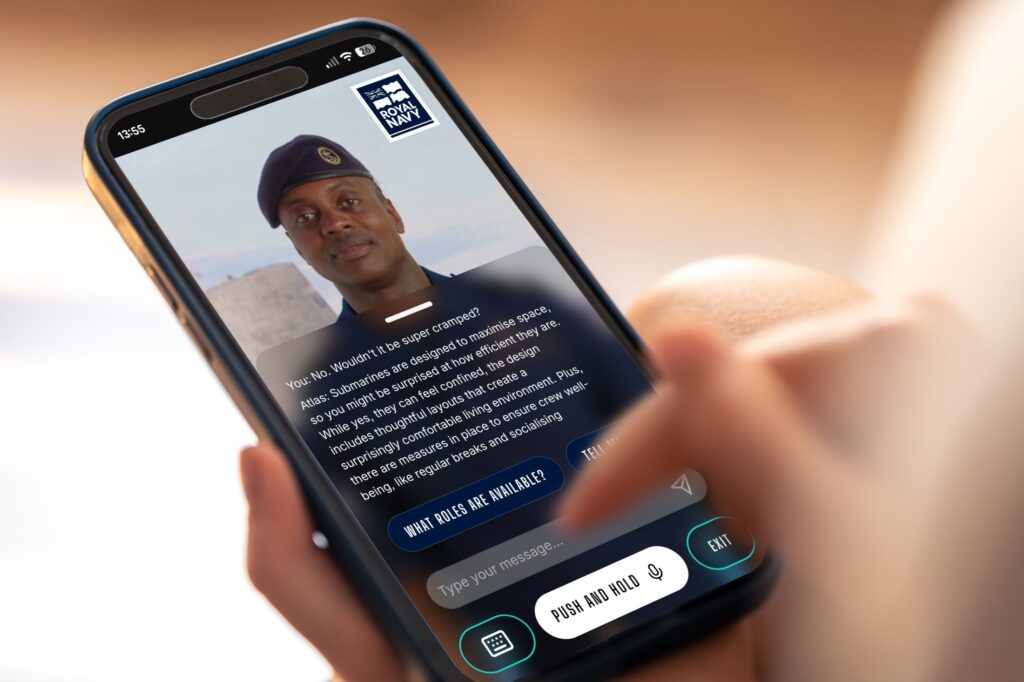

The Royal Navy is handing the first line of its recruitment operations to a real-time AI avatar called Atlas.
Atlas is powered by a large language model and has been deployed to field questions from prospective submariners. The deployment shows how AI can support a shift from slow text-based triage to fast and immersive automated support.
Public sector IT projects often suffer from bloated timelines and vague deliverables, but the Navy’s latest deployment is grounded in hard operational metrics. The launch of Atlas follows a specific business case: the need to filter and support candidates for one of the service’s most demanding roles while reducing the administrative burden on human staff.
The data behind the deployment
The Royal Navy, working with WPP Media’s Wavemaker, has spent years refining its automated entry points. Before the avatar, there was a text-based assistant.
That initial system, which was recently upgraded to a full LLM and retrieval-augmented generation (RAG) solution, proved the efficacy of the model. It fielded over 460,000 queries from more than 165,000 users and logged a 93 percent satisfaction rate.
More importantly for the bottom line, the text-based system slashed the workload for live-agent teams by 76 percent. It also generated 89,000 expressions of interest, proving that automation could widen the funnel without overwhelming the recruiting officers. Atlas is effectively the visual evolution of those successes, designed to arrest the attention of a younger demographic that engages differently with digital channels.
Under the hood of the AI recruitment avatar
The architecture relies on a multi-vendor ecosystem rather than a single-source solution. Wavemaker led the strategic direction and conversational design, ensuring the “brain” of the operation was trained on the correct knowledge base. Voxly Digital built the front and back end, supported by Great State, the Navy’s digital agency.
Functionally, Atlas does more than recite policy. It uses a conversational interface that is multimedia-enabled. If a candidate asks about life on a submarine – a notorious pain point for recruitment conversion due to the unique lifestyle – Atlas can respond with spoken answers, on-screen captions, and relevant videos or quotes from serving personnel.
The goal is to keep the user in the ecosystem longer. Atlas will be trialled at events and linked directly to the NavyReady app and the Enterprise Customer Relationship Management (e-CRM) programme, ensuring data continuity.
Augmentation, not replacement
Despite the high degree of automation, the Royal Navy frames this AI avatar as a workforce augmentation tool for recruitment.
Paul Colley, Head of Marketing at the Royal Navy, was explicit about the boundaries of the technology: “When it comes to AI, our focus is on how we can use it responsibly and strategically to better arm the teams we have. It’s not about replacing…
Source link
Disclaimer
We strive to uphold the highest ethical standards in all of our reporting and coverage. We blogs.grocliq.com want to be transparent with our readers about any potential conflicts of interest that may arise in our work. It’s possible that some of the investors we feature may have connections to other businesses, including competitors or companies we write about. However, we want to assure our readers that this will not have any impact on the integrity or impartiality of our reporting. We are committed to delivering accurate, unbiased news and information to our audience, and we will continue to uphold our ethics and principles in all of our work. Thank you for your trust and support.
Website Upgradation is going on for any glitch kindly connect at [email protected]