

LLMs like ChatGPT, Gemini, and Claude now sit across search, content generation, and recommendations.
Now, 80% of tech buyers rely on generative AI at least as much as traditional search to research vendors, according to a Responsive survey of B2B buyers.
This effective transfer of trust in AI discovery has become an enablement tool for B2B buyers, quietly deciding which brands get remembered and which get ignored.
And those decisions, once invisible, are now measurable.
Previsible has been studying this shift through a new lens called LLM perception drift, the month-over-month change in how AI models reference and position brands inside a given category. (Disclosure: I’m the CEO and co-founder of Previsible.)
Using recent data from Evertune, which tracks brand visibility within model outputs, we focused on a single case study: the project management software space, comparing September 2025 to October 2025.
The results show how rapidly AI brand perception is evolving, and why that volatility is about to become the next major SEO metric.
Key insights
- LLM perception drift is solidifying as a new visibility metric for SEO and B2B marketing.
- Project management and adjacent enterprise brands saw meaningful movement, with tools like Atlassian surging while Trello, Slack, and Monday.com posted notable drops, according to recent data from Evertune.
- These movements reveal that AI brand perception is dynamic and measurable, reshaping how marketers understand authority and semantic relevance inside large language models.
- In 2026, AI brand signal stability will become central to maintaining digital relevance as LLMs evolve and retraining cycles accelerate.
A subtle shake-up inside the AI mind
Evertune’s AI brand score tracks how likely a large language model is to recommend a brand without being prompted by name.
The score captures two things: how often the brand appears in AI responses (visibility) and where it ranks when it does (average position).
Between September and October, project management brands saw big swings in their scores, signaling real shifts in the AI’s internal brand landscape.
Some of the more striking movements:
- Slack saw one of the most dramatic drops (-8.10).
- Trello fell sharply (-5.59).
- Monday.com (-0.78) and ClickUp (-0.74) also declined.
Meanwhile, gains concentrated around ecosystem and enterprise-connected brands:
- Atlassian jumped (+5.50).
- Microsoft (+2.08).
- Google (+3.62).
- Professional services firms like Deloitte (+5.00), KPMG (+4.00), PwC (+2.45), and EY (+2.75) also climbed.
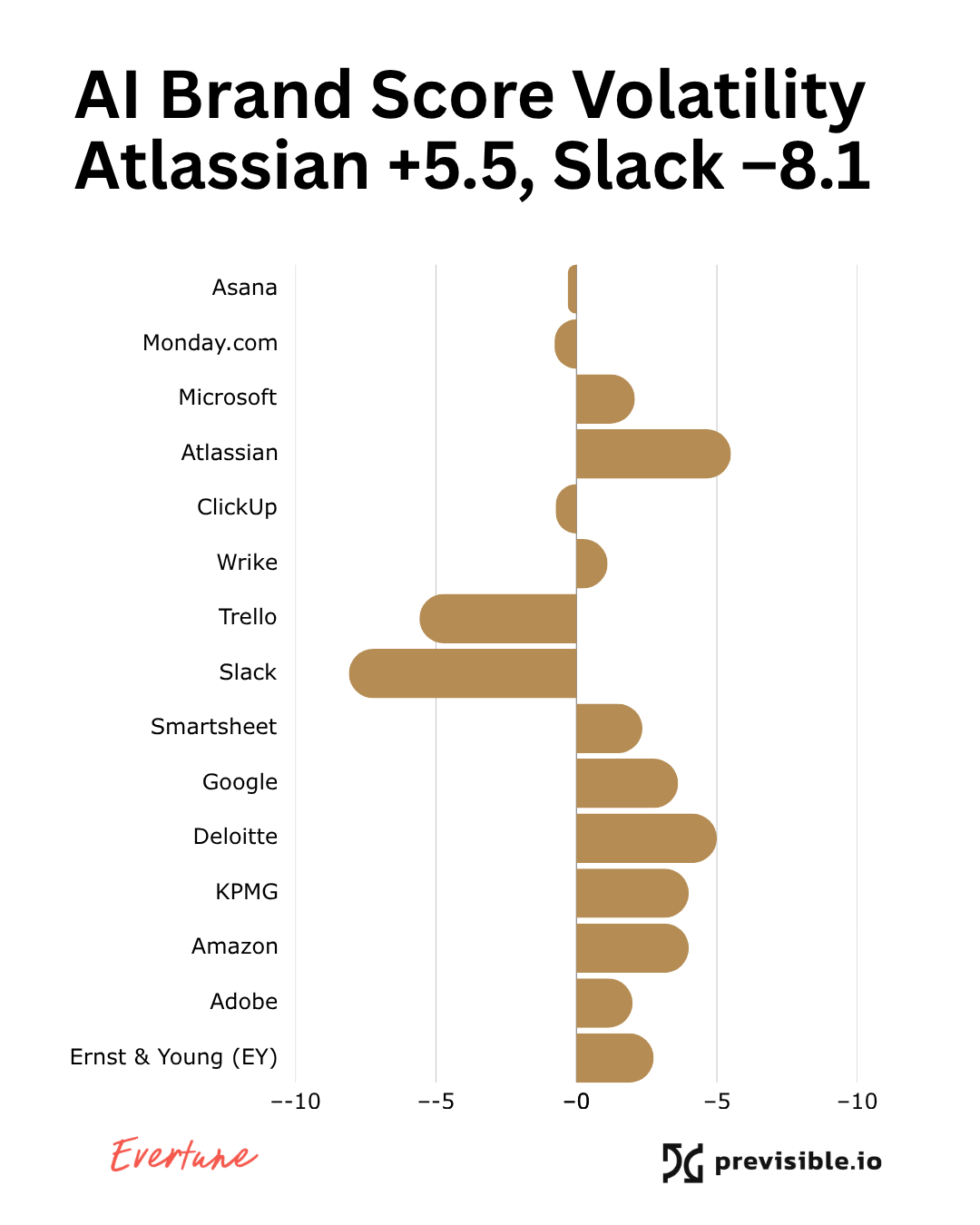
At face value, it looks like a leaderboard reshuffle.
But beneath the surface, the shift reflects something deeper – a measurable change in the AI’s unaided brand awareness, a drift in how the model perceives and prioritizes brands, even when nothing visible changed in the market itself.
The meaning behind the drift
The data suggests two…
Source link
Disclaimer
We strive to uphold the highest ethical standards in all of our reporting and coverage. We blogs.grocliq.com want to be transparent with our readers about any potential conflicts of interest that may arise in our work. It’s possible that some of the investors we feature may have connections to other businesses, including competitors or companies we write about. However, we want to assure our readers that this will not have any impact on the integrity or impartiality of our reporting. We are committed to delivering accurate, unbiased news and information to our audience, and we will continue to uphold our ethics and principles in all of our work. Thank you for your trust and support.
Website Upgradation is going on for any glitch kindly connect at [email protected]