
When Emily Epstein shared her perspective on LinkedIn about how “people didn’t stop reading books when encyclopedias came out,” it sparked a conversation about the future of primary sources in an AI-driven world.
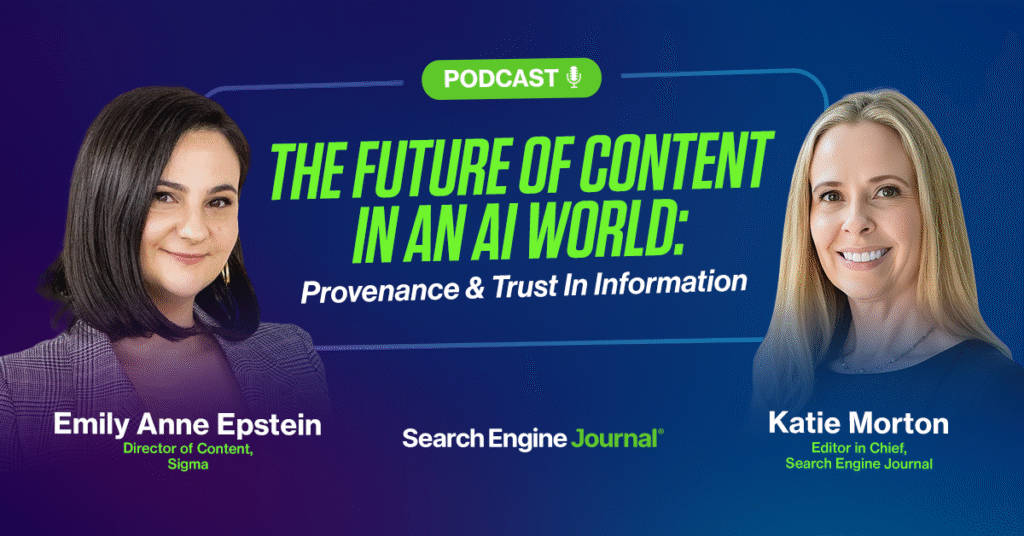
In this episode, Katie Morton, Editor-in-Chief of Search Engine Journal, and Emily Anne Epstein, Director of Content at Sigma, dig into her post and unpack what AI really means for publishers, content creators, and marketers now that AI tools present shortcuts to knowledge.
Their discussion highlights the importance of provenance, the layers involved in online knowledge acquisition, and the need for more transparent editorial standards.
If you’re a content creator, this episode can help you gain insight into how to provide value as the competition for attention becomes a competition for trust.
Watch the video or read the full transcript below:
Katie Morton: Hello, everybody. I’m Katie Morton, Editor-in-Chief of Search Engine Journal, and today I’m sitting down with Emily Anne Epstein, Director of Content at Sigma. Welcome, Emily.
Emily Ann Epstein: Thanks so much. I’m so excited to be here.
Katie: Me too. Thanks for chatting with me. So Emily wrote a really excellent post on LinkedIn that caught my attention. Emily, for our audience, would you mind summarizing that post for us?
Emily: So this should feel both shocking and non-shocking to everybody. But the idea is, people didn’t stop reading books when encyclopedias came out. And this is a response to the hysteria that’s going on with the way AI tools are functioning as summarizing devices for complicated and complex situations. And so the idea is, just because there’s a shortcut now to acquiring knowledge, it doesn’t mean we’re getting rid of the need for primary sources and original sources.
These two different types of knowledge acquisition exist together, and they layer on top of one another. You may start your book report with an encyclopedia or ChatGPT search, but what you find there doesn’t matter if you can’t back it up. You can’t just say in a book report, “I heard it in Encarta.” Where did the information come from? I think about the way this is going to transform search: There’s simply going to be layers now.
Maybe start your search with an AI tool, but you’ll need to finish somewhere else that organizes primary sources, provides deeper analysis, and even shows contradictions that go into creating knowledge.
Because a lot of what these synthesized summaries do is present a calm, “impartial” view of reality. But we all know that’s not true. All knowledge is biased in some way because it cannot be “all-containing.”
The Importance Of Provenance
Katie: I want to talk about something you mentioned in your LinkedIn post: provenance. What needs to happen, whether culturally, editorially, or socially, for “show me the source material” to become standard in AI-assisted…
Source link
Disclaimer
We strive to uphold the highest ethical standards in all of our reporting and coverage. We blogs.grocliq.com want to be transparent with our readers about any potential conflicts of interest that may arise in our work. It’s possible that some of the investors we feature may have connections to other businesses, including competitors or companies we write about. However, we want to assure our readers that this will not have any impact on the integrity or impartiality of our reporting. We are committed to delivering accurate, unbiased news and information to our audience, and we will continue to uphold our ethics and principles in all of our work. Thank you for your trust and support.
Website Upgradation is going on for any glitch kindly connect at [email protected]