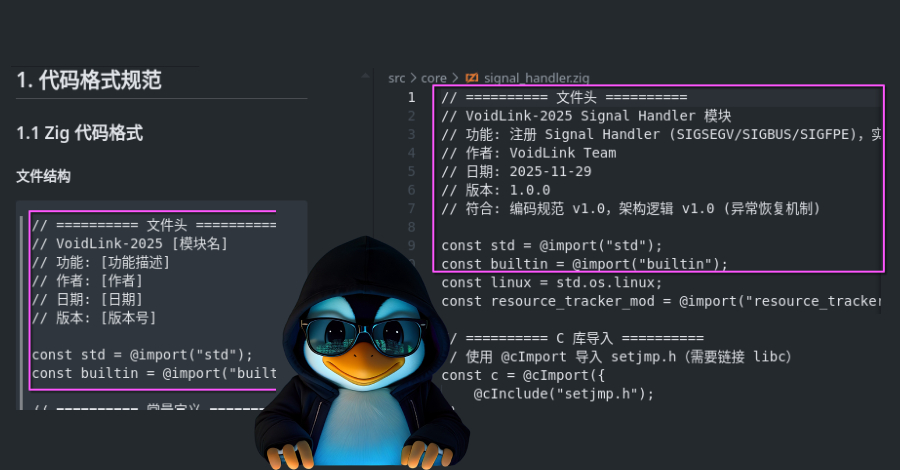


The recently discovered sophisticated Linux malware framework known as VoidLink is assessed to have been developed by a single person with assistance from an artificial intelligence (AI) model.
That’s according to new findings from Check Point Research, which identified operational security blunders by malware’s author that provided clues to its developmental origins. The latest insight makes VoidLink one of the first instances of an advanced malware largely generated using AI.
“These materials provide clear evidence that the malware was produced predominantly through AI-driven development, reaching a first functional implant in under a week,” the cybersecurity company said, adding it reached more than 88,000 lines of code by early December 2025.
VoidLink, first publicly documented last week, is a feature-rich malware framework written in Zig that’s specifically designed for long-term, stealthy access to Linux-based cloud environments. The malware is said to have come from a Chinese-affiliated development environment. As of writing, the exact purpose of the malware remains unclear. No real-world infections have been observed to date.

A follow-up analysis from Sysdig was the first to highlight the fact that the toolkit may have been developed with the help of a large language model (LLM) under the directions of a human with extensive kernel development knowledge and red team experience, citing four different pieces of evidence –
- Overly systematic debug output with perfectly consistent formatting across all modules
- Placeholder data (“John Doe”) is typical of LLM training examples embedded in decoy response templates
- Uniform API versioning where everything is _v3 (e.g., BeaconAPI_v3, docker_escape_v3, timestomp_v3)
- Template-like JSON responses covering every possible field
“The most likely scenario: a skilled Chinese-speaking developer used AI to accelerate development (generating boilerplate, debug logging, JSON templates) while providing the security expertise and architecture themselves,” the cloud security vendor noted late last week.
Check Point’s Tuesday report backs up this hypothesis, stating it identified artifacts suggesting that the development in itself was engineered using an AI model, which was then used to build, execute, and test the framework – effectively turning what was a concept into a working tool within an accelerated timeline.
 |
| High-level overview of the VoidLink Project |
“The general approach to developing VoidLink can be described as Spec Driven Development (SDD),” it noted. “In this workflow, a developer begins by specifying what they’re building, then creates a plan, breaks that plan into tasks, and only then allows an agent to implement it.”
It’s believed that the threat actor commenced work on the VoidLink in late November 2025, leveraging a coding agent known as TRAE SOLO to carry out the tasks. This assessment is based on the presence of TRAE-generated helper files that have been copied along with the…
Source link
Disclaimer
We strive to uphold the highest ethical standards in all of our reporting and coverage. We blogs.grocliq.com want to be transparent with our readers about any potential conflicts of interest that may arise in our work. It’s possible that some of the investors we feature may have connections to other businesses, including competitors or companies we write about. However, we want to assure our readers that this will not have any impact on the integrity or impartiality of our reporting. We are committed to delivering accurate, unbiased news and information to our audience, and we will continue to uphold our ethics and principles in all of our work. Thank you for your trust and support.
Website Upgradation is going on for any glitch kindly connect at [email protected]