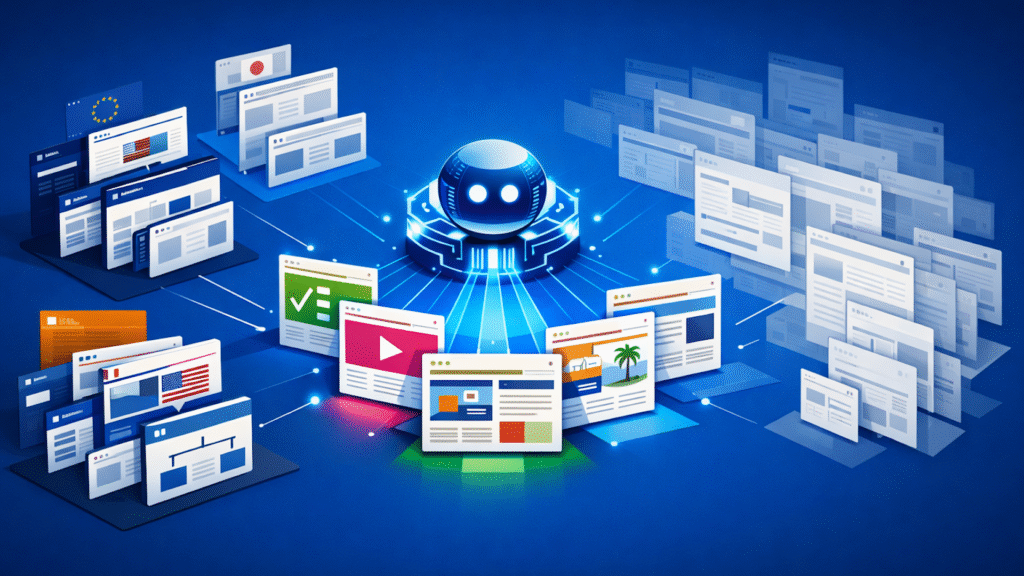

For more than a decade, international SEO has followed a familiar playbook:
- Create dedicated country- and language-specific URLs.
- Localize the content.
- Deploy hreflang.
- Let search engines rank and serve the correct version.
In the AI-mediated search environment, that playbook is no longer enough.
In 2026, consistent global visibility is determined less by traditional ranking mechanics and more by how effectively content is retrieved, interpreted, and validated.
What still works in 2026
The following fundamentals continue to shape international SEO outcomes in 2026.
Market-scoped URLs with real differences still win
One of the clearest dividing lines in 2026 is between true market-scoped content and translated replicas.
Country-specific URLs continue to perform when they reflect real market differences, such as:
- Legal disclosures.
- Pricing or currency.
- Availability and eligibility.
- Shipping, returns, or compliance requirements.
Content that reflects local intent, rather than language alone, is more likely to be retrieved and retained.
By contrast, identical page structures across markets, shared offers, CTAs, and entity relationships, or simple language swaps without intent differentiation, are increasingly treated as redundant.
When two pages answer the same intent, AI systems detect semantic equivalence and select a single representative version, regardless of language.
Dig deeper: How to craft an international SEO approach that balances tech, translation and trust
Hreflang works, but AI redefines its limits
Hreflang remains one of the most reliable tools in international SEO, particularly in traditional SERPs, which are still dominant worldwide.
When implemented correctly, it prevents duplication issues, supports proper canonical resolution, and ensures users land on the correct country or language version of a page.
However, its influence is not universal across all modern search experiences.
In AI-mediated retrieval and synthesis workflows, content selection can occur before hreflang signals are evaluated or without consulting them at all.
AI systems may select a single upstream representation for synthesis.
In these cases, hreflang has no mechanism to influence which version is chosen, and may not be applied anywhere in the AI response pipeline.
In AI-driven environments, market differentiation, entity clarity, local authority, and content freshness must already be established before retrieval occurs.
Once content collapses at the semantic level, hreflang cannot resolve equivalence after the fact.
Entity clarity determines whether pages are considered at all
In 2026, your focus should be more about entity clarity.
AI-driven systems must rapidly resolve:
- Who is this organization?
- Which brand or product is involved?
- Which market context applies?
- Which version should be trusted?
When those relationships are…
Source link
Disclaimer
We strive to uphold the highest ethical standards in all of our reporting and coverage. We blogs.grocliq.com want to be transparent with our readers about any potential conflicts of interest that may arise in our work. It’s possible that some of the investors we feature may have connections to other businesses, including competitors or companies we write about. However, we want to assure our readers that this will not have any impact on the integrity or impartiality of our reporting. We are committed to delivering accurate, unbiased news and information to our audience, and we will continue to uphold our ethics and principles in all of our work. Thank you for your trust and support.
Website Upgradation is going on for any glitch kindly connect at [email protected]