

Cybersecurity teams increasingly want to move beyond looking at threats and vulnerabilities in isolation. It’s not only about what could go wrong (vulnerabilities) or who might attack (threats), but where they intersect in your actual environment to create real, exploitable exposure.
Which exposures truly matter? Can attackers exploit them? Are our defenses effective?
Continuous Threat Exposure Management (CTEM) can provide a useful approach to the cybersecurity teams in their journey towards unified threat/vulnerability or exposure management.
What CTEM Really Means
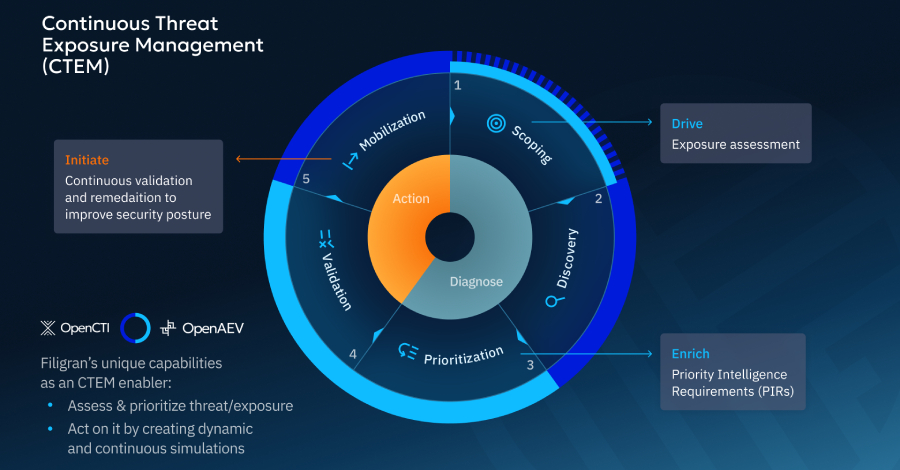
CTEM, as defined by Gartner, emphasizes a ‘continuous’ cycle of identifying, prioritizing, and remediating exploitable exposures across your attack surface, which improves your overall security posture as an outcome. It’s not a one-off scan and a result delivered via a tool; it’s an operational model built on five steps:
- Scoping – assess your threats and vulnerabilities and identify what’s most important: assets, processes, and adversaries.
- Discovery – Map exposures and attack paths across your environment to anticipate an adversary’s actions.
- Prioritization – Focus on what attackers can realistically exploit, and what you need to fix.
- Validation – Test assumptions with safe, controlled attack simulations.
- Mobilization – Drive remediation and process improvements based on evidence
What is the Real Benefit of CTEM
CTEM shifts the focus to risk-based exposure management, integrating lots of sub-processes and tools like vulnerability assessment, vulnerability management, attack surface management, testing, and simulation. CTEM unifies exposure assessment and exposure validation, with the ultimate objective for security teams to be able to record and report potential impact to cyber risk reduction. Technology or tools have never been an issue; in fact, we have a problem of plenty in the cybersecurity space. At the same time, with more tools, we have created more siloes, and this is exactly what CTEM sets out to challenge – can we unify our view into threats/vulnerabilities/attack surfaces and take action against truly exploitable exposure to reduce overall cyber risk?
Role of Threat Intelligence in CTEM
Thousands of vulnerabilities are reported every year (the number was more than 40,000 in 2024), but less than 10% are actually ever exploited. Threat Intelligence can significantly help you zero in on the ones that matter for your organization by connecting vulnerabilities to adversary tactics, techniques, and procedures (TTPs) observed in active campaigns. Threat intelligence is no longer a good-to-have but is a need-to-have. It can help you specify Priority Intelligence Requirements (PIRs): the context, the threat landscape that matters most in your environment. This prioritized threat intelligence tells you which flaws are being weaponized, against which targets, and under what conditions, so you…
Source link
Disclaimer
We strive to uphold the highest ethical standards in all of our reporting and coverage. We blogs.grocliq.com want to be transparent with our readers about any potential conflicts of interest that may arise in our work. It’s possible that some of the investors we feature may have connections to other businesses, including competitors or companies we write about. However, we want to assure our readers that this will not have any impact on the integrity or impartiality of our reporting. We are committed to delivering accurate, unbiased news and information to our audience, and we will continue to uphold our ethics and principles in all of our work. Thank you for your trust and support.
Website Upgradation is going on for any glitch kindly connect at [email protected]