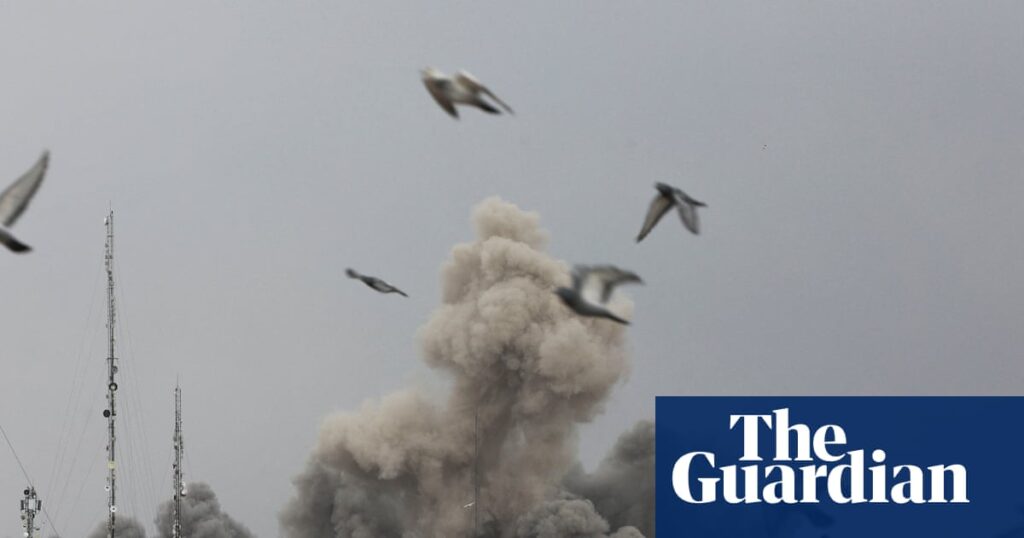

The use of AI tools to enable attacks on Iran heralds a new era of bombing quicker than “the speed of thought”, experts have said, amid fears human decision-makers could be sidelined.
Anthropic’s AI model, Claude, was reportedly used by the US military in the barrage of strikes as the technology “shortens the kill chain” – meaning the process of target identification through to legal approval and strike launch.
The US and Israel, which previously used AI to identify targets in Gaza, launched almost 900 strikes on Iranian targets in the first 12 hours alone, during which Israeli missiles killed Iran’s supreme leader, Ayatollah Ali Khamenei.
Academics studying the field say AI is collapsing the planning time required for complex strikes – a phenomenon known as “decision compression”, which some fear could result in human military and legal experts merely rubber-stamping automated strike plans.
In 2024 the San Francisco-based Anthropic deployed its model across the US Department of War and other national security agencies to speed up war planning. Claude became part of a system developed by the war-tech company Palantir with the Pentagon to “dramatically improve intelligence analysis and enable officials in their decision-making processes”.
“The AI machine is making recommendations for what to target, which is actually much quicker in some ways than the speed of thought,” said Craig Jones, a senior lecturer in political geography at Newcastle University and an expert in kill chains. “So you’ve got scale and you’ve got speed, you’re [carrying out the] assassination-style strikes at the same time as you’re decapitating the regime’s ability to respond with all the aerial ballistic missiles. That might have taken days or weeks in historic wars. [Now] you’re doing everything at once.”
The latest AI systems can rapidly analyse mountains of information on potential targets from drone footage to telecommunications interceptions as well as human intelligence. Palantir’s system uses machine learning to identify and prioritise targets and recommend weaponry, accounting for stockpiles and previous performance against similar targets. It also uses automated reasoning to evaluate legal grounds for a strike.
“This is the next era of military strategy and military technology,” said David Leslie, professor of ethics, technology and society at Queen Mary University of London, who has observed demonstrations of AI military systems. He also warned that reliance on AI can result in “cognitive off-loading”. Humans tasked with making a strike decision can feel detached from its consequences because the effort to think it through has been made by a machine.
On Saturday 165 people, many children, were killed in a missile strike that hit a school in southern Iran, according to state media. It appeared to be close to a military barracks and the UN called it “a grave violation of humanitarian law”. The US military has…
Source link
Disclaimer
We strive to uphold the highest ethical standards in all of our reporting and coverage. We blogs.grocliq.com want to be transparent with our readers about any potential conflicts of interest that may arise in our work. It’s possible that some of the investors we feature may have connections to other businesses, including competitors or companies we write about. However, we want to assure our readers that this will not have any impact on the integrity or impartiality of our reporting. We are committed to delivering accurate, unbiased news and information to our audience, and we will continue to uphold our ethics and principles in all of our work. Thank you for your trust and support.
Website Upgradation is going on for any glitch kindly connect at [email protected]