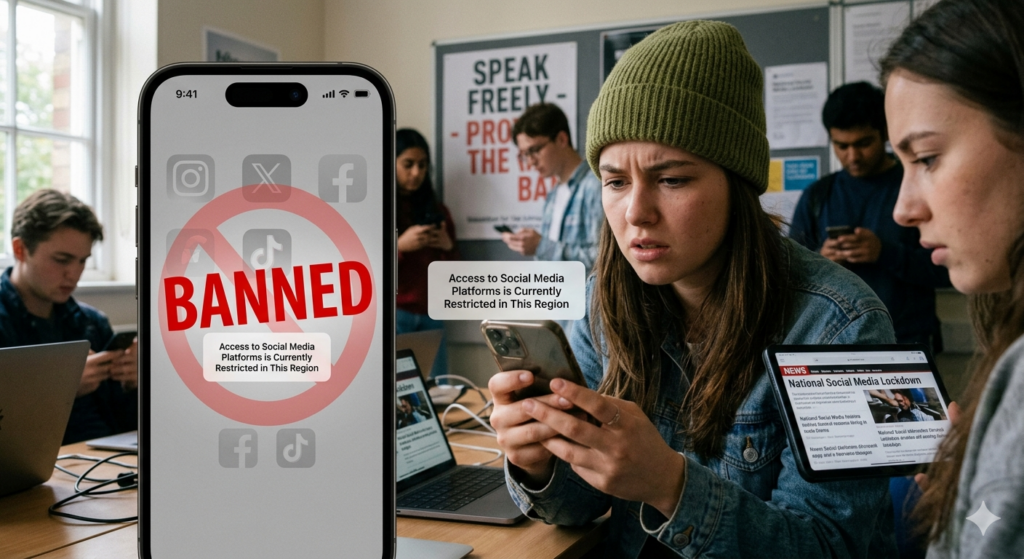

Karnataka Chief Minister Siddaramaiah’s 2026–27 budget speech announced plans to ban social-media access for children under 16. Op-eds and posts on X and LinkedIn reveal a sharp debate over whether the move protects children or creates new policy and privacy risks. At the time of writing, the budget speech has announced the proposal as an intention, but the government has not released specific details regarding draft legislation, the legal process, or implementation measures.
Rising Anxiety And Addiction: Why Some Support The Ban
Harsh Vardhan Goenka, Chairman of RPG Enterprises, wrote on X that it is a “good step by the Karnataka government,” highlighting several risks children face online:
- “Too much social media is linked to rising anxiety and stress.”
- Platforms are “designed to keep young minds addicted for hours.”
- “Cyberbullying, fake news and harmful content.”
He compared the restriction to other limits placed on minors: “We don’t allow alcohol, tobacco or driving for minors. Similarly, limits on social media for children are also necessary”.
Furthermore, others linked social media use directly to visible behavioural changes among students. Amrit Raj, co-founder of Women in Product India, wrote on LinkedIn that increased screen time is affecting young users’ social behaviour: “Shorter attention spans. Difficulty holding a conversation. A constant need for stimulation.”
He also criticised the pressure created by online comparison culture, writing that children are “measuring their lives against highlight reels” and “filtered, fabricated versions of reality.” According to him, children need physical activity, offline connections, and “experiences that build emotional intelligence”.
Adding to the discussion, entrepreneur Arjun Vaidya also pointed to studies linking heavy social-media use with “anxiety, depression, sleep disruption and self-harm behaviour”. He argued that governments are increasingly viewing the issue as “a public health concern for children”.
A Blunt Approach That Misses the Core Issue
Some argue that banning social media oversimplifies the issue. In an op-ed in The Indian Express, Angelina Dash noted that blanket restrictions serve as a blunt response to a complex problem. She recommended that policymakers address the underlying issues in platform design and digital behaviour rather than relying solely on prohibition.
Similarly, strategic advisor Srinath Sridharan posted on LinkedIn that, while concerns about digital platforms are legitimate, “the solution is not.” According to…
Source link
Disclaimer
We strive to uphold the highest ethical standards in all of our reporting and coverage. We blogs.grocliq.com want to be transparent with our readers about any potential conflicts of interest that may arise in our work. It’s possible that some of the investors we feature may have connections to other businesses, including competitors or companies we write about. However, we want to assure our readers that this will not have any impact on the integrity or impartiality of our reporting. We are committed to delivering accurate, unbiased news and information to our audience, and we will continue to uphold our ethics and principles in all of our work. Thank you for your trust and support.
Website Upgradation is going on for any glitch kindly connect at [email protected]