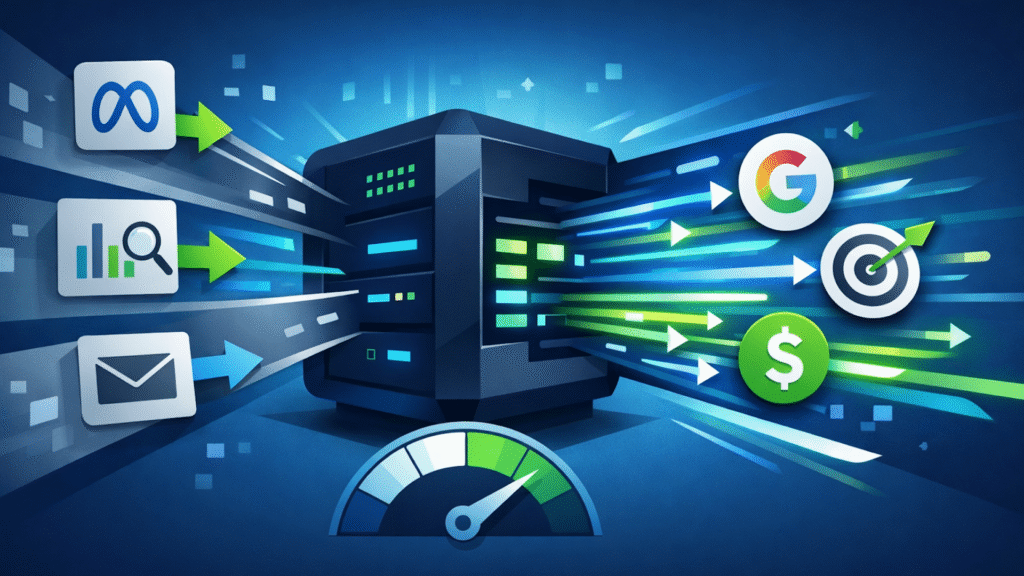

Privacy laws are tightening, browser extensions are blocking data, and ad platforms are demanding cleaner data. As a result, how you track user behavior online is changing fast.
Server-side tagging can help you reduce data loss while collecting cleaner, privacy-compliant data.
Here’s what server-side tagging is, when it makes sense to implement it, and our experience with providers like Elevar and Littledata.
What is server-side tagging?
Traditionally, tracking scripts like Meta Pixel or Google Analytics run in the browser. This is client-side (browser-side) tagging. With server-side tagging, those scripts run on a server you control instead of the visitor’s browser.
Instead of the browser sending data directly to multiple third parties, it sends events to a first-party server endpoint (often a Google Tag Manager server-side container). The server processes, enriches, and forwards the data to tools like Meta and Google Analytics — on infrastructure you host (such as Google Cloud Run) or through managed providers like Elevar or Stape.
This allows for:
- More control over your data.
- Cleaner page performance.
- Better alignment with privacy laws.
Beyond these benefits, server-side tagging gives you more flexibility in how you enrich and transform data before it reaches ad platforms.
You can standardize event names, filter out low-quality events, and add custom parameters to improve audience segmentation. This creates a more reliable, unified data foundation across tools like Meta, Google Ads, and Klaviyo, leading to stronger optimization signals and more confident decisions.
Your customers search everywhere. Make sure your brand shows up.
The SEO toolkit you know, plus the AI visibility data you need.
Start Free Trial
Get started with

Is server-side tagging right for you?
Server-side tagging isn’t a one-size-fits-all solution, but for many brands it’s becoming essential. It may be the right choice for you if:
You need to meet strict privacy or compliance requirements
Server-side setups don’t automatically anonymize data, but they give you more control over how it’s processed and shared.
This makes it easier to support compliance with regulations like GDPR, CCPA, and platform consent requirements.
You can apply consent logic, filter or hash sensitive fields, and control which events and parameters you send to each platform based on user permissions.
You want faster website performance
Client-side tracking can slow page load times.
Server-side tagging helps your site run faster by shifting data processing off the browser and onto the server, boosting user experience and SEO.
Faster pages can improve conversion rates and reduce bounce rates, especially on mobile, where every millisecond counts.
You want more accurate tracking (despite ad blockers)
Ad…
Source link
Disclaimer
We strive to uphold the highest ethical standards in all of our reporting and coverage. We blogs.grocliq.com want to be transparent with our readers about any potential conflicts of interest that may arise in our work. It’s possible that some of the investors we feature may have connections to other businesses, including competitors or companies we write about. However, we want to assure our readers that this will not have any impact on the integrity or impartiality of our reporting. We are committed to delivering accurate, unbiased news and information to our audience, and we will continue to uphold our ethics and principles in all of our work. Thank you for your trust and support.
Website Upgradation is going on for any glitch kindly connect at [email protected]