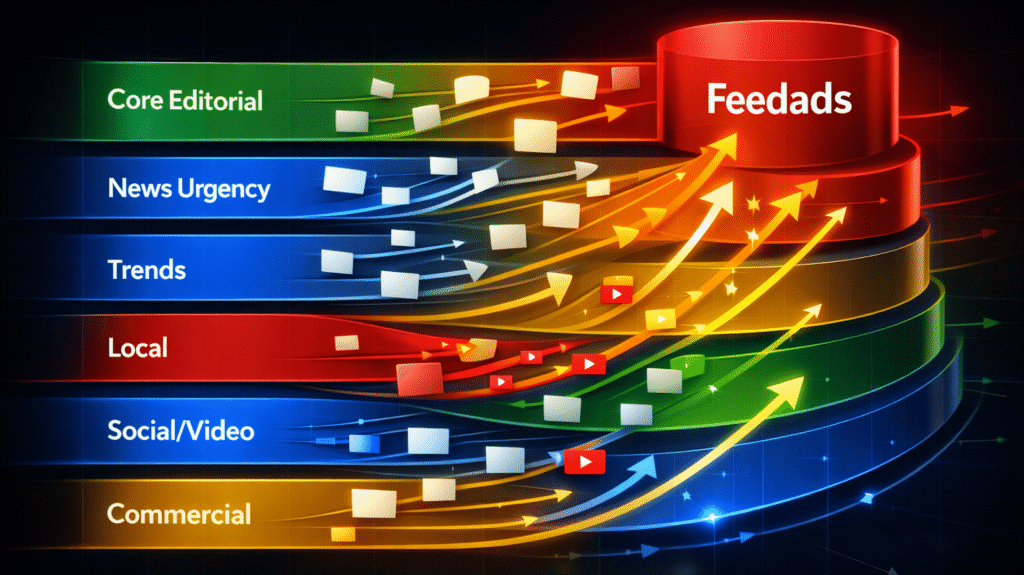

Metehan Yesilyurt’s SDK analysis revealed the pipeline names. We captured months of real Discover feeds to show what each pipeline actually does — volume, reach, timing, and which publishers dominate. Here’s what 42 million cards reveal about Discover’s internal architecture.
What we did
Over three months (December 2025 – February 2026), we observed real Discover feeds from hundreds of devices. The result: 42 million feed cards analyzed. We linked each card to the precise pipeline that selected it.
Some of the names were already known from the SDK, You likely saw the SDK Analysis by Metehan Yesilyurt already. What was missing: what each pipeline does in practice. How much content it selects, how many devices see it, how fast it operates, and which publishers it favors. That’s what our data reveals.
For each pipeline, we compute four metrics:
- Reach — percentage of devices that see each URL per day
- Speed — median age of articles at time of appearance
- Exclusivity — percentage of URLs unique to that pipeline
- Volume — share of total feed
Explore all 20 pipelines visually: Open the interactive explorer →

Not one algorithm — a layered system
The common assumption: Discover uses a single recommendation algorithm. Our data tells a different story: it’s a structured system with six functional layers, each with distinct logic, speed, and audience.


The six layers:
- Core editorial — content (34.2% of volume), moonstone (7.8%, reach 9.4%), aura (8.7%, science/tech over-represented), paginationpanoptic (5.5%, scroll infrastructure), relatedcontentruby (6.7%, click-triggered related content).
- News urgency — mustntmiss (0.5% volume but 7.3% reach, ~2x priority boost, 29% AI Overviews content) and newsstoriesheadlines (10.6% reach, Google News story clusters).
- Trends — deeptrendsfable detects, deeptrends persists. Sequential pipeline: 27% pass rate, 21-hour delay. x.com is a trend signal source even in EN.
- Local/geo — geotargetingstories (x.com dominates at 43.2% in EN), webkicklocalstories (hyperlocal UK/US press, 67% exclusive URLs), astria (BBC 29.3%, horse racing, astrology, Showcase).
- Social/video — the YouTube cascade: creatorcontent (YouTube 72.4%) → freshvideos (+15h, 94% YouTube) → neoncluster (+23h, 100% YouTube, 13% reach). The cascade that doesn’t exist in French.
- Commercial —…
Source link
Disclaimer
We strive to uphold the highest ethical standards in all of our reporting and coverage. We blogs.grocliq.com want to be transparent with our readers about any potential conflicts of interest that may arise in our work. It’s possible that some of the investors we feature may have connections to other businesses, including competitors or companies we write about. However, we want to assure our readers that this will not have any impact on the integrity or impartiality of our reporting. We are committed to delivering accurate, unbiased news and information to our audience, and we will continue to uphold our ethics and principles in all of our work. Thank you for your trust and support.
Website Upgradation is going on for any glitch kindly connect at [email protected]