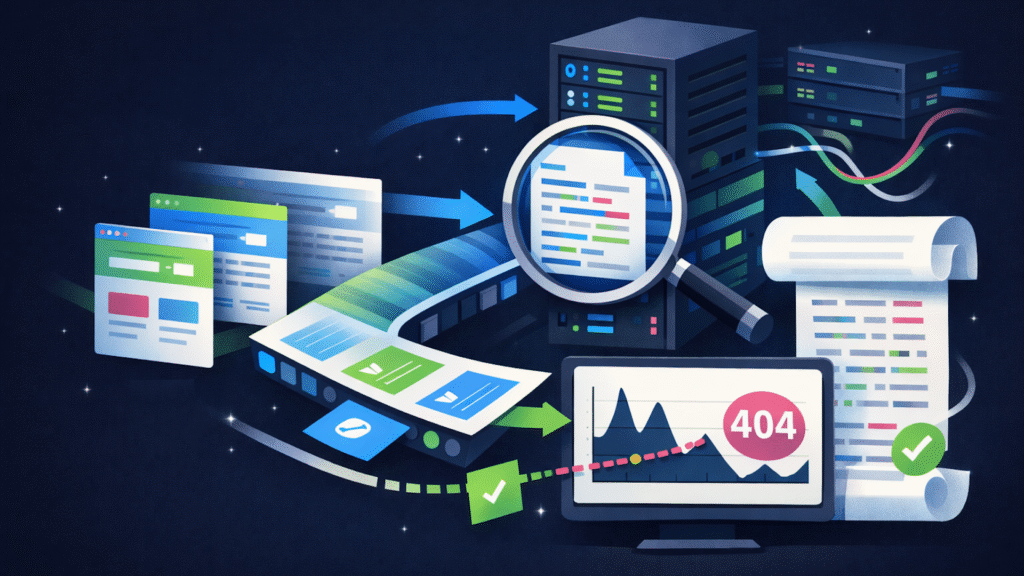

One of the biggest challenges in AI search is that visibility is being shaped by systems you can’t directly observe.
Nothing like Google Search Console exists for ChatGPT, Claude, or Perplexity. No reporting layer showing what’s crawled, how often, or whether your content is considered at all.
Yet these systems are actively crawling the web, building datasets, powering retrieval, and generating answers that shape discovery — often without sending traffic back to the source.
This creates a gap. In traditional SEO, performance and behavior are connected. You can see impressions, clicks, indexing, and some level of crawl data. In AI search, that feedback loop doesn’t exist.
Log files are the closest thing to that missing layer. They don’t summarize or interpret activity. They record it — every request, every URL, every crawler.
For AI systems, that raw data is often the only way to understand how your site is actually being accessed.
Some visibility is emerging — just not from AI platforms
That lack of visibility hasn’t gone entirely unaddressed.
Bing is one of the first platforms to introduce this natively. Through Bing Webmaster Tools, Copilot-related insights are beginning to show how AI-driven systems interact with websites. It’s still early, but it’s a meaningful shift — and the first real example of an AI system exposing even part of its behavior to site owners.
Beyond that, a new category of tools is emerging. Platforms like Scrunch, Profound, and others focus on AI visibility, tracking how content appears in AI-generated responses and how different agents interact with a site.
In some cases, they connect directly to sources like Cloudflare or other traffic layers, making it easier to monitor crawler activity without manually exporting and analyzing raw logs.
That visibility is useful, especially as AI systems evolve quickly. But it isn’t complete.
Most of these tools operate within a defined window. Some only surface a limited timeframe of agent activity, making them effective for near-term monitoring, but less useful for understanding longer-term patterns or changes in crawl behavior.
AI crawler activity isn’t consistent. Unlike Googlebot, which crawls continuously, many AI agents appear sporadically or in bursts. Without historical data, it’s difficult to determine whether a change in activity is meaningful or normal variation.
Log files solve for that. They provide a complete, unfiltered record of crawler behavior — every request, every URL, every user agent. With continuous retention, they enable analysis of patterns over time and revisiting data when something changes.
Dig deeper: Log file analysis for SEO: Find crawl issues & fix them fast
Your customers search everywhere. Make sure your brand shows up.
The SEO toolkit you know, plus the AI visibility data you need.
Start Free…
Source link
Disclaimer
We strive to uphold the highest ethical standards in all of our reporting and coverage. We blogs.grocliq.com want to be transparent with our readers about any potential conflicts of interest that may arise in our work. It’s possible that some of the investors we feature may have connections to other businesses, including competitors or companies we write about. However, we want to assure our readers that this will not have any impact on the integrity or impartiality of our reporting. We are committed to delivering accurate, unbiased news and information to our audience, and we will continue to uphold our ethics and principles in all of our work. Thank you for your trust and support.
Website Upgradation is going on for any glitch kindly connect at [email protected]