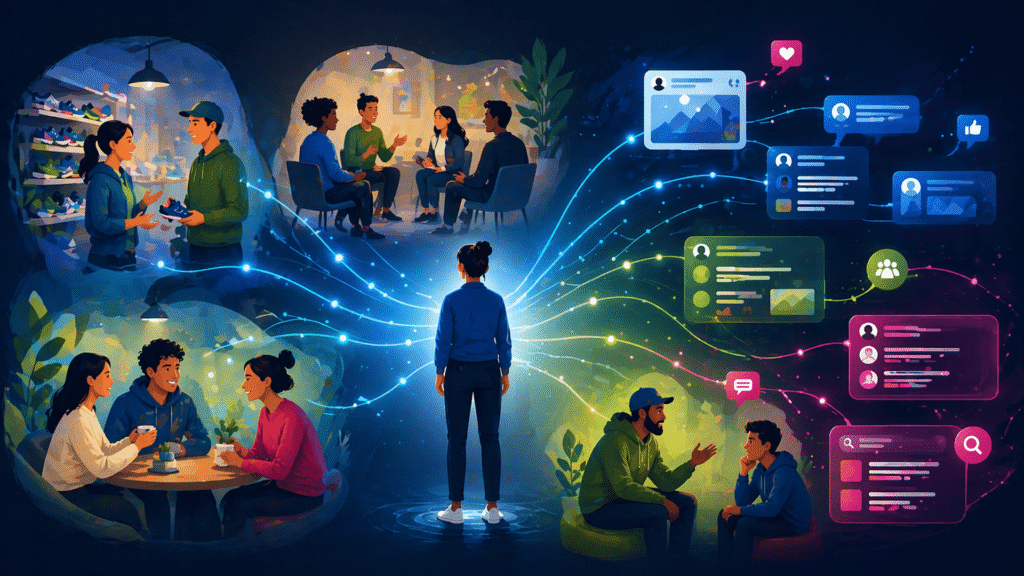

Attention is fragmenting further every day as the platforms providing information continue to multiply.
There are new players on the scene, like AI search, while companies build proprietary spaces through social networks and communities. Smaller spaces pop up daily through vibe-coded apps. Many of these platforms are noisier than ever, with everyone demanding our attention at once.
We’re drowning in information, and trust is eroding in sources like search engines and social media. We still use these platforms for research, but go elsewhere to validate what we find and make decisions.
We’re shifting back to a source we’ve trusted since the beginning: other people. That means showing up across multiplying platforms and in as many people-led sources as possible.
Search is a trust experience
Rachel Botsman is a leading expert and author on trust in the modern world. Botsman defines trust as:
- “A confident relationship with the unknown.”
I’ve read tons of different definitions of trust, but this is by far my favorite. It’s the simplest and touches on the core component of dealing with the unknown or uncertainty.
We don’t need trust when outcomes feel certain. We need trust when we’re dealing with the unknown.
Searching for information is what humans do when they’re uncertain. There are three trust layers that occur every time we search for information:
- Self-trust (I’m uncertain.): I don’t trust that I have the information I need to make a decision at this moment in time.
- Platform trust (Where I trust to search for answers.): Which platform, community, or real-world space do I trust to find answers to my questions?
- Source trust (Whose or what information I act on.): Do I trust this enough to believe it, click on it, buy it, let it guide me, or change my mind? People can absolutely skip platform trust and jump directly here.
Searching for information is a trust experience from start to finish. It’s a human behavior, and, as we’ll discover, the best way to support human behavior is through other humans.
Your customers search everywhere. Make sure your brand shows up.
The SEO toolkit you know, plus the AI visibility data you need.
Start Free Trial
Get started with

An example of my own search journey to find a trusted answer
Here’s what a recent search journey of mine looked like when I was interested in buying a new pair of shoes.
I started with AI tools and did some low-trust research, getting a list of options that met my requirements from ChatGPT and cross-referencing that list with Claude’s output.
Then I wanted a sense of pricing and delivery timelines (high trust), so I quickly read through reviews while I was still working with the AI outputs (low trust). I searched Amazon for the options surfaced by ChatGPT and Claude, read reviews, got pricing, and…
Source link
Disclaimer
We strive to uphold the highest ethical standards in all of our reporting and coverage. We blogs.grocliq.com want to be transparent with our readers about any potential conflicts of interest that may arise in our work. It’s possible that some of the investors we feature may have connections to other businesses, including competitors or companies we write about. However, we want to assure our readers that this will not have any impact on the integrity or impartiality of our reporting. We are committed to delivering accurate, unbiased news and information to our audience, and we will continue to uphold our ethics and principles in all of our work. Thank you for your trust and support.
Website Upgradation is going on for any glitch kindly connect at [email protected]