
About a year ago, I came out of a meeting with engineers about improving automations for content briefs. A few days later, someone on the analytics team — unrelated to those conversations — pinged me that they’d built a content brief generator using various data pipelines and APIs.
That’s when I realized “getting people to use AI” isn’t the hard part. Implementation and integration are.
Most SEO teams don’t struggle with access to tools; they struggle to prioritize efforts with outsized impact and align across the organization.
One team is experimenting with prompts, another is auto-generating briefs, and a third is building dashboards no one asked for, often stepping on each other’s toes. Each has something valuable to contribute, but much of it gets diluted by duplication and a race to execution.
Leadership wants speed. Legal wants caution. Developers want clarity.
The result is fragmentation, not the AI marketing transformation teams need. If AI is going to meaningfully change SEO performance, it has to be structured before it’s scaled. Otherwise, fragmentation only accelerates.
After working with large, complex organizations navigating this shift, I’ve found three frameworks that consistently prevent chaos and create momentum. Used together, they align vision, clarify what to automate, and turn prioritization into execution.
1. The AI SEO City: Alignment before acceleration
The biggest obstacle in AI adoption is coordination. SEO already sits at the intersection of engineering, content, analytics, product, and brand. Now, with AI search and the rise of social search, add organic social, conversion rate optimization, affiliates, and creative to the mix.
AI touches all of these surfaces, but it’s too much for any one person or team. Without a shared mental model, groups move independently, duplication creeps in, and accountability blurs — turning AI into an arms race instead of a productivity driver.
Leading large teams and working with many Fortune 100 executives, I’ve seen how analogies help teams quickly grasp complex ideas. Research supports this: analogies improve understanding and the transfer of ideas across domains. When teams map new concepts onto familiar structures, alignment accelerates.
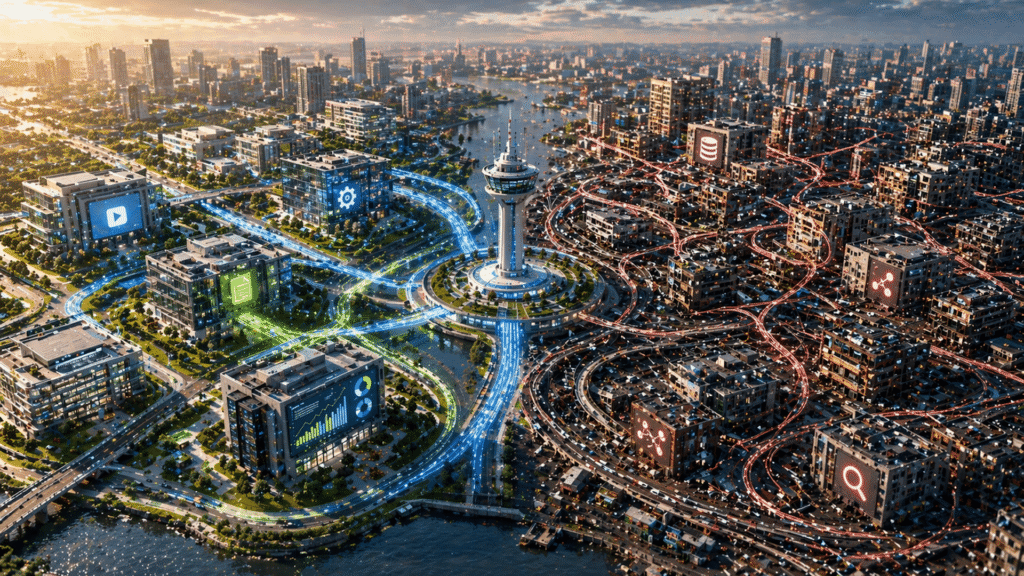
Enter: the AI SEO City. Instead of explaining AI as a series of tools and experiments, imagine your SEO ecosystem as a city.
Your website (also known as SEO house) no longer exists in a silo. Technical SEO is the foundation. Content hubs frame the rooms. Off-site SEO is the curb appeal. User experience is the staging.
With AI search, that house now interacts with a broader city in a more integrated way. Platforms like TikTok, Reddit, YouTube, and Amazon influence the answers AI systems produce.
To succeed in AI search, this city needs a strong planner to advocate for budgets, plan what’s next, and maintain what works. The SEO team is the planner, while other teams…
Source link
Disclaimer
We strive to uphold the highest ethical standards in all of our reporting and coverage. We blogs.grocliq.com want to be transparent with our readers about any potential conflicts of interest that may arise in our work. It’s possible that some of the investors we feature may have connections to other businesses, including competitors or companies we write about. However, we want to assure our readers that this will not have any impact on the integrity or impartiality of our reporting. We are committed to delivering accurate, unbiased news and information to our audience, and we will continue to uphold our ethics and principles in all of our work. Thank you for your trust and support.
Website Upgradation is going on for any glitch kindly connect at [email protected]