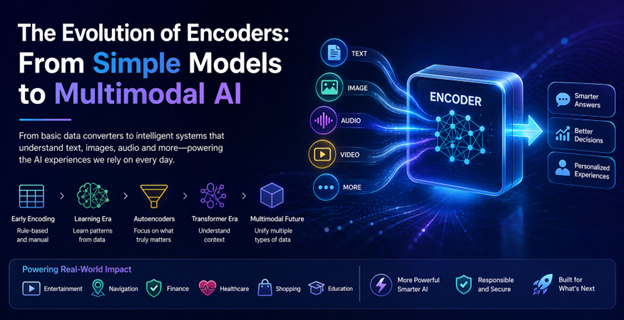

When people talk about artificial intelligence, they usually focus on what it produces: Human-like text, stunning images, or eerily accurate recommendations. What rarely gets attention is how AI understands anything in the first place. That understanding begins with encoders. Think of an encoder as a translator that converts messy, real-world information into a structured language machines can work with.
Over time, encoders have quietly evolved from simple data converters into sophisticated systems capable of understanding multiple forms of information at once. This transformation didn’t happen overnight. It’s a story of gradual progress, practical challenges, and breakthroughs driven by real-world needs.
The beginning: When encoding was just a technical step
In the early days of machine learning, encoding was more of a technical necessity than an intelligent process. Developers had to manually decide how to represent data. If a system needed to understand categories like “small,” “medium,” and “large,” those labels had to be converted into numbers.
This worked, but only to a point. The system didn’t truly understand anything; it just processed numbers. For example, an early online store might recommend products based on basic categories, but it couldn’t grasp subtle relationships. Someone buying running shoes wouldn’t necessarily be shown fitness watches or hydration gear unless those links were explicitly programmed.
In short, early encoders handled data, not meaning.
Learning instead of being told
Everything started to change when neural networks entered the picture. Instead of relying entirely on human instructions, systems began learning patterns directly from data. Encoders became more than converters, they became learners.
Take image recognition as a real-world example. Instead of telling a system what defines a cat’s ears, whiskers, tail developers could train it on thousands of images. The encoder would gradually figure out patterns on its own. This change made AI far more adaptable and accurate.
The same idea applied to language. Words were not symbols; they became vector mathematical representations capturing meaning and relationships. That’s why modern search engines can understand that “cheap flights” and “budget airfare” are closely related, even though the wording is different.
Autoencoders: Finding what really matters
A major leap came with the introduction of autoencoders. These models were designed with a simple but powerful idea: compress data and then reconstruct it. To do this successfully, the encoder had to identify what truly mattered and ignore everything else.
This approach proved incredibly useful in real-world scenarios. In banking, for instance, autoencoders are used to detect fraud. By learning what “normal” behaviour looks like, they can quickly spot unusual transactions. If someone suddenly makes a high-value purchase in a different country, the system flags it not because it was told…
Source link
Disclaimer
We strive to uphold the highest ethical standards in all of our reporting and coverage. We blogs.grocliq.com want to be transparent with our readers about any potential conflicts of interest that may arise in our work. It’s possible that some of the investors we feature may have connections to other businesses, including competitors or companies we write about. However, we want to assure our readers that this will not have any impact on the integrity or impartiality of our reporting. We are committed to delivering accurate, unbiased news and information to our audience, and we will continue to uphold our ethics and principles in all of our work. Thank you for your trust and support.
Website Upgradation is going on for any glitch kindly connect at [email protected]