
New technologies come and go. Early in my career, I often chased shiny new things in an attempt to be on the cutting edge, but it didn’t take more than a few years to realize I was spending countless hours of my time, and my clients’ time, implementing technologies and techniques that went by the wayside. Google Authorship, anyone?
It turns out that if you simply wait for wider — but still early — adoption, learn from the first movers’ mistakes, and catch up quickly, you can avoid wasting time and create greater value for yourself and those you serve. That lesson has served me well.
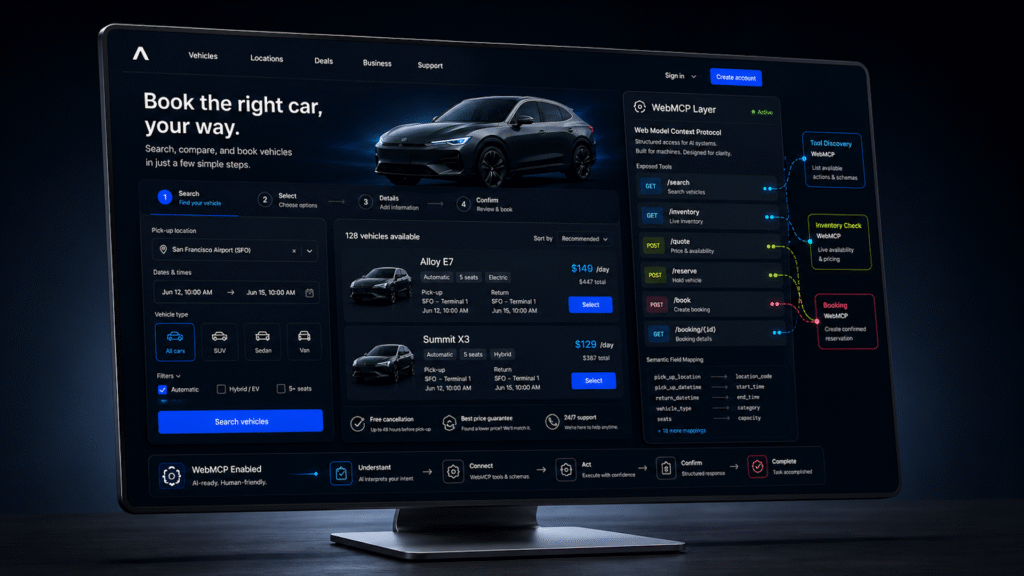
And then there are those key moments where the early movers stand to not just win in the current landscape, but to shape and lead the next one. Think of the first people reading the PageRank paper and thinking, “I should build some links.” WebMCP feels like one of those moments, only bigger.
It’s not just a revolution in how search works or even in generative engine visibility. We’re at a moment where the very place discoverability occurs is changing, and who (or rather, what) is doing the discovering is changing with it.
Coming soon: Non-human engagement
While SEOs have long debated whether we should be optimizing for search engines or humans (shockingly, it’s both), that paradigm is about to be turned on its head. What happens when discovery shifts from a human to an LLM or agentic system?
This change is already underway. Whenever you visit ChatGPT with a request, it makes decisions, runs supplemental searches, asks follow-up questions, and returns conclusions. The agent is planning and deciding on your behalf, and your resulting output is shaped entirely by what it retrieves and how it interprets it.
We can even see the supplemental (fanout) queries in DevTools:

I think of this as the latest chapter in a longer story:
- Discovery v1: People interacted with the world and discovered things firsthand. Experience and word of mouth were the discovery points.
- Discovery v2: People started writing things down. Libraries and educational institutions became the discovery points, followed by newspapers and books.
- Discovery v3: The web proliferates information and media at a scale previously unimaginable. Directories, then search engines, rose to aid discovery.
- Discovery v4 (current): After about 25 years of search engines, LLMs rose and discovery moved to a blended, LLM-forward format. Light agentic capabilities are baked in to assist retrieval. People are still in the loop, but the assistant is doing more of the legwork.
- Discovery v5 (on the horizon): Agentic systems move beyond being assistants in the retrieval and presentation layer and are given autonomy to act on users’ behalf. Many users will have their own agents. Companies will offer them. Google almost certainly will.
I would argue that the stage we’re entering, Discovery v5, will be the most dramatic since the shift to v2.
Can’t you…
Source link
Disclaimer
We strive to uphold the highest ethical standards in all of our reporting and coverage. We blogs.grocliq.com want to be transparent with our readers about any potential conflicts of interest that may arise in our work. It’s possible that some of the investors we feature may have connections to other businesses, including competitors or companies we write about. However, we want to assure our readers that this will not have any impact on the integrity or impartiality of our reporting. We are committed to delivering accurate, unbiased news and information to our audience, and we will continue to uphold our ethics and principles in all of our work. Thank you for your trust and support.
Website Upgradation is going on for any glitch kindly connect at [email protected]