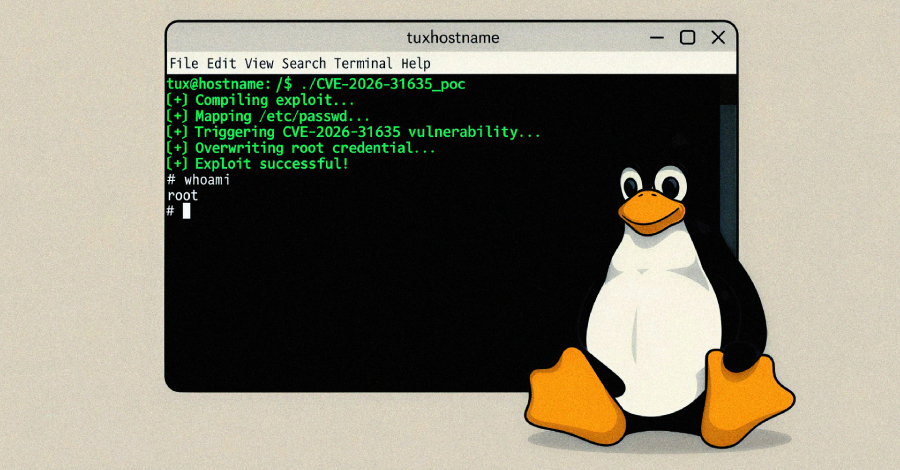


Proof-of-concept (PoC) exploit code has now been released for a recently patched security flaw in the Linux kernel that could allow for local privilege escalation (LPE).
Dubbed DirtyDecrypt (aka DirtyCBC), the vulnerability was discovered and reported by the Zellic and V12 security team on May 9, 2026, only to be informed by the maintainers that it was a duplicate of a vulnerability that had already been patched in the mainline.
“It’s a rxgk pagecache write due to missing COW [copy-on-write] guard in rxgk_decrypt_skb,” Zellic co-founder Luna Tong (aka cts and gf_256) said in a description shared on GitHub.
Although the CVE identifier was not disclosed, the vulnerability in question is CVE-2026-31635 (CVSS score: 7.5) based on the fact that the NIST National Vulnerability Database (NVD) includes a link to the DirtyDecrypt PoC in its CVE record.
“The specific fault sits in rxgk_decrypt_skb(), the function that decrypts an incoming sk_buff (socket buffer) on the receive side,” Moselwal said.
“In this code path the kernel handles memory pages that are partly shared with the page cache of other processes – a normal Linux optimisation protected by copy-on-write: as soon as a write to a shared page happens, a private copy is made beforehand so that the write doesn’t bleed into another process’s data.”
The absence of this COW guard in rxgk_decrypt_skb means that data gets written to the memory of privileged processes or, depending on the exploit path, to the page cache of privileged files, such as etc/shadow, /etc/sudoers, or a SUID binary, leading to local privilege escalation.
DirtyDecrypt impacts only distributions with CONFIG_RXGK enabled, such as Fedora, Arch Linux, and openSUSE Tumbleweed. In containerized environments, worker nodes running a vulnerable version of Linux could provide a pathway to escape the pod.
The vulnerability, per Zellic, is assessed to be a variant of Copy Fail (CVE-2026-31431), Dirty Frag aka Copy Fail 2 (CVE-2026-43284 and CVE-2026-43500), and Fragnesia (CVE-2026-46300), all of which grant root access on vulnerable systems.
Copy Fail, a local privilege escalation flaw in the AF_ALG cryptographic socket interface, was disclosed by researchers at Theori on April 29, 2026. It was followed by Dirty Frag a week later. Dirty Frag expands on Copy Fail with two page-cache write primitives.
However, security researcher Hyunwoo Kim was forced to go ahead with public disclosure after the agreed-upon embargo window ended prematurely when a merged patch for CVE-2026-43284 on May 5 led another researcher, who was unaware of the embargo, to analyze and independently publish details of the defect.
“I read the commit, recognized the xfrm ESP-in-UDP MSG_SPLICE_PAGES no-COW path against shared pipe pages as an LPE primitive, and built a PoC,” the researcher, who goes by the online aliases 0xdeadbeefnetwork and afflicted.sh, noted. “The work is n-day weaponization from a public upstream commit, which is standard practice once a…
Source link
Disclaimer
We strive to uphold the highest ethical standards in all of our reporting and coverage. We blogs.grocliq.com want to be transparent with our readers about any potential conflicts of interest that may arise in our work. It’s possible that some of the investors we feature may have connections to other businesses, including competitors or companies we write about. However, we want to assure our readers that this will not have any impact on the integrity or impartiality of our reporting. We are committed to delivering accurate, unbiased news and information to our audience, and we will continue to uphold our ethics and principles in all of our work. Thank you for your trust and support.
Website Upgradation is going on for any glitch kindly connect at [email protected]