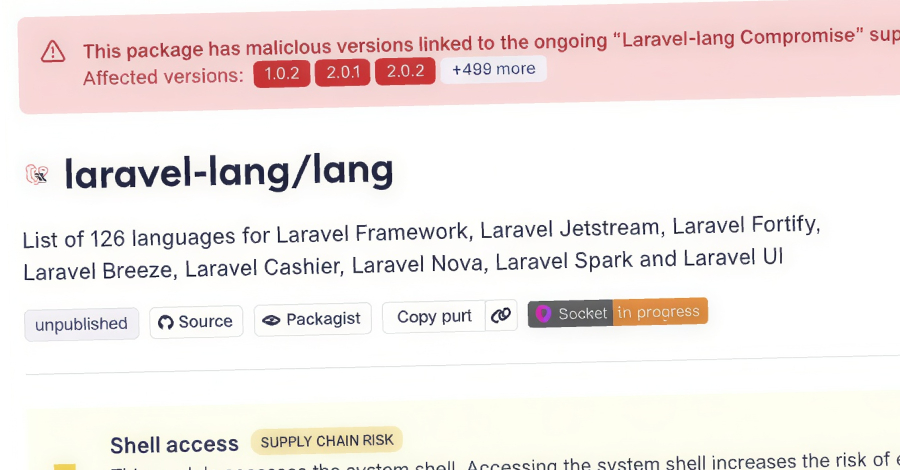


Cybersecurity researchers have flagged a fresh software supply chain attack campaign that has targeted multiple PHP packages belonging to Laravel-Lang to deliver a comprehensive credential-stealing framework.
The affected packages include –
- laravel-lang/lang
- laravel-lang/http-statuses
- laravel-lang/attributes
- laravel-lang/actions
“The timing and pattern of the newly published tags point to a broader compromise of the Laravel Lang organization’s release process, rather than a single malicious package version,” Socket said. “The tags were published in rapid succession on May 22 and May 23, 2026, with many versions appearing only seconds apart.”
More than 700 versions associated with these packages have been identified, indicating automated mass tagging or republishing. It’s suspected that the attacker may have managed to obtain access to organization-level credentials, repository automation, or release infrastructure.
The core malicious functionality is located in a file named “src/helpers.php” that’s embedded into the version tags. It’s mainly designed to fingerprint the infected host and contact an external server (“flipboxstudio[.]info”) to retrieve a PHP-based cross-platform payload that runs on Windows, Linux, and macOS.
According to Aikido Security, the dropper delivers a Visual Basic Script launcher on Windows and runs it via cscript. On Linux and macOS, it executes the stealer payload via exec().
“Because this file [‘src/helpers.php’] is registered in the composer.json under autoload.files, the backdoor is executed automatically on every PHP request handled by the compromised application,” Socket explained.
“The script generates a unique per-host marker (an MD5 hash combining the directory path, system architecture, and inode) to ensure the payload only triggers once per machine. This prevents redundant executions and helps the malware remain undetected after the initial run.”
The stealer is equipped to harvest a wide range of data from compromised systems and exfiltrate it to the same server. This includes –
- IAM roles and instance identity documents by querying cloud metadata endpoints
- Google Cloud application default credentials
- Microsoft Azure access tokens and service principal profiles
- Kubernetes Service Account tokens and Helm registry configurations
- Authentication tokens for DigitalOcean, Heroku, Vercel, Netlify, Railway and Fly.io
- HashiCorp Vault tokens
- Tokens and configurations from Jenkins, GitLab Runners, GitHub Actions, CircleCI, TravisCI, and ArgoCD
- Seed phrases and files associated with cryptocurrency wallets (Electrum, Exodus, Atomic, Ledger Live, Trezor, Wasabi, and Sparrow) and extensions (MetaMask, Phantom, Trust Wallet, Ronin, Keplr, Solflare, and Rabby)
- Browser history, cookies, and login data from Google Chrome, Microsoft Edge, Mozilla Firefox, Brave, and Opera by using a Base64-encoded embedded Windows executable…
Source link
Disclaimer
We strive to uphold the highest ethical standards in all of our reporting and coverage. We blogs.grocliq.com want to be transparent with our readers about any potential conflicts of interest that may arise in our work. It’s possible that some of the investors we feature may have connections to other businesses, including competitors or companies we write about. However, we want to assure our readers that this will not have any impact on the integrity or impartiality of our reporting. We are committed to delivering accurate, unbiased news and information to our audience, and we will continue to uphold our ethics and principles in all of our work. Thank you for your trust and support.
Website Upgradation is going on for any glitch kindly connect at [email protected]