

Imagine working in SEO for years, researching a problem you know inside and out, only to have an LLM confidently explain why your experience is wrong.
That happened to me. Actually, it happened three different times last week with Gemini.
The scary part wasn’t that the answers were obviously bad. It was that they sounded good. The responses were polished, believable, and directionally accurate enough that most people would never question them.
And if you aren’t deeply familiar with the topic, you probably wouldn’t know how to challenge the answer.
Funny enough, I caught it twice. The third time cost me money. All within the same week.
Example 1: Gemini educates me on technical SEO
Let me give you some context.
I’m currently helping migrate a client’s FAQ hub from a provider-hosted subdomain to a self-hosted implementation.
The FAQ lives under a /faq/ folder, but individual Q&A pages are parameter-based URLs. Normally not an issue… except Shopify forces canonicals back to the root /faq/ page, effectively preventing those pages from being indexed.
While researching Shopify-specific solutions and duplication considerations, Gemini gave me this response:

Excuse me?!
You will absolutely not be penalized for conflicting SEO signals.
At best, Google indexes what it wants. At worst, it ignores directives it doesn’t trust.
The bigger issue is the wording.
“Penalty” is basically the magic word in SEO. The moment leadership hears it, priorities shift, momentum dies, and recommendations become harder to implement.
Then Gemini doubled down.
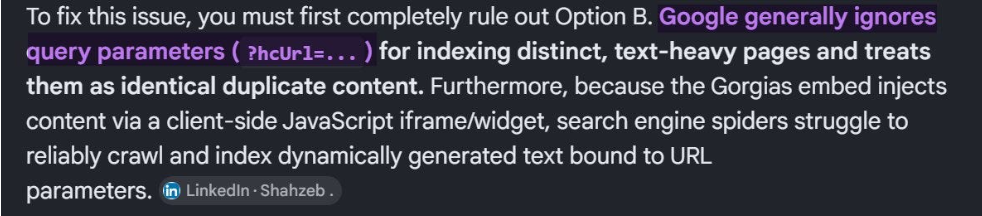
I asked whether removing the canonicals and allowing the parameter pages to exist independently was an option.
Gemini responded:
- “Google generally ignores query parameters.”
Wow… just wow.
Below is an implementation I worked on with the Saatva team, where we intentionally indexed parameter URLs within the shopping experience.
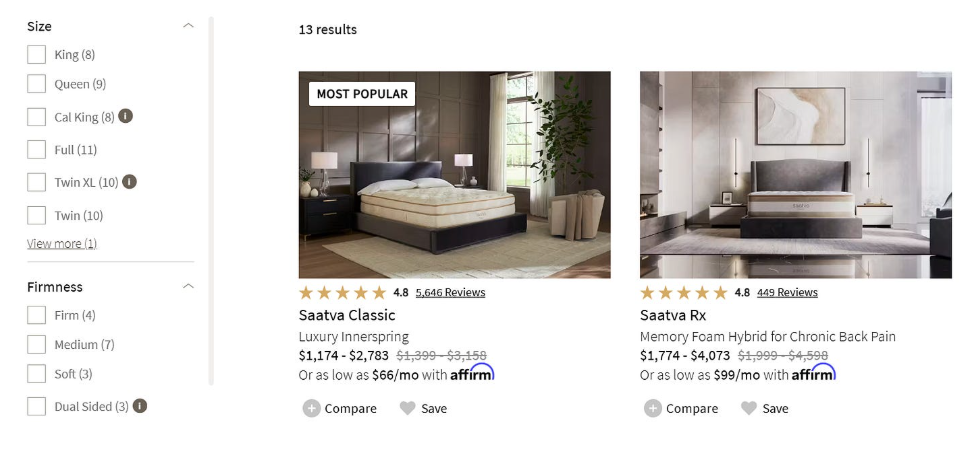
Search Console and URL inspection confirmed those pages indexed just fine.
Parameter pages can absolutely rank, index, and generate value.
The problem isn’t that Gemini was wrong (as in it’s a more difficult implementation).
It’s that the answer sounded believable enough that someone without SEO experience would probably accept it and move on.

Example 2: Gemini says solve the issue with a $3,000 part
This one hit differently because I’m not a mechanic.
I’ve been troubleshooting an issue on my Jeep SRT and spent hours outside in the sun collecting data, testing fuses, reviewing OBD2 logs, and trying to narrow down the root cause. After reviewing everything, Gemini confidently concluded the issue was likely a rear differential failure and suggested a full replacement.
Estimated damage? Roughly $3,000 in OEM parts alone.

The response sounded fantastic. It was detailed, logical, and even complimented my troubleshooting process.
The…
Source link
Disclaimer
We strive to uphold the highest ethical standards in all of our reporting and coverage. We blogs.grocliq.com want to be transparent with our readers about any potential conflicts of interest that may arise in our work. It’s possible that some of the investors we feature may have connections to other businesses, including competitors or companies we write about. However, we want to assure our readers that this will not have any impact on the integrity or impartiality of our reporting. We are committed to delivering accurate, unbiased news and information to our audience, and we will continue to uphold our ethics and principles in all of our work. Thank you for your trust and support.
Website Upgradation is going on for any glitch kindly connect at [email protected]