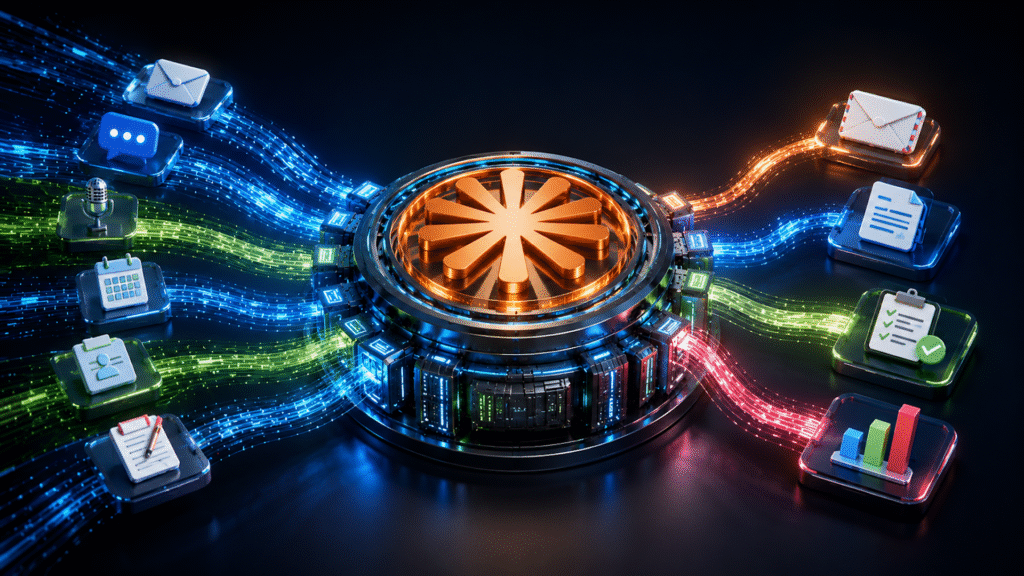

If you run or work in an agency, manage clients, or own anything more than a single workflow, you know how the first 45 minutes of the morning vanish into Gmail, Slack, Fireflies, the CRM, and whatever doc was last on screen, just trying to remember what mattered the day before.
It used to be I’d be thinking about a pricing decision I owed the agency team, a roadmap call for my habit-tracking app, three Slack threads I’d half-read on my phone the night before, and a sales follow-up that needed to go out today.
Those days are over. About six months ago, I rebuilt how I work using Claude Code as the engine of what I’ll call my second brain. The Monday morning synthesis now takes about a minute.
Here’s what I built, why, and how you can do the same.
Why most second-brain setups break down
The “second brain” idea isn’t new. Tiago Forte’s “Building a Second Brain,” the PARA method, Notion, and Obsidian were all built on the same instinct: externalize what you’d otherwise try to remember.
Capturing information works. Recall mostly works. But the bit that adds value is what happens after recall: turning what’s stored into something you can act on.
Three failure modes show up in almost every implementation I’ve seen:
- Passive storage. Information goes in. It sits there. The only way out is search plus your own memory of what you tagged it. Meeting notes are a perfect example.
- Context-switching tax. Even when you find the right note, you’re still copy-pasting and re-prompting your way to a usable output.
- No action layer. A second brain that can’t draft, retrieve, or execute tasks can end up giving you more work than you started with. Over time, it builds up into an excess of notes that just leads to cognitive overload.
Documenting tasks isn’t the problem. The problem is that the documents and conversations are scattered across a hundred different apps, and nothing reads across them.
What’s missing is the layer on top: something that can pull from all of it and actually do the work.
Dig deeper: How to turn Claude Code into your SEO command center
Your customers search everywhere. Make sure your brand shows up.
The SEO toolkit you know, plus the AI visibility data you need.
Start Free Trial
Get started with

How Claude Code changes the equation
Most general-purpose AI assistants are stuck behind a chat window. They can answer questions, but they can’t reach into your file system, remember what you said last week, or do anything outside their own UI.
Claude Code (Anthropic’s developer-focused agent) ticks four boxes that, together, change how you can operate day to day:
- Native file system access: It reads and writes inside an actual project folder, accessing your local files like any directory.
- Persistent, structured memory: It remembers across sessions…
Source link
Disclaimer
We strive to uphold the highest ethical standards in all of our reporting and coverage. We blogs.grocliq.com want to be transparent with our readers about any potential conflicts of interest that may arise in our work. It’s possible that some of the investors we feature may have connections to other businesses, including competitors or companies we write about. However, we want to assure our readers that this will not have any impact on the integrity or impartiality of our reporting. We are committed to delivering accurate, unbiased news and information to our audience, and we will continue to uphold our ethics and principles in all of our work. Thank you for your trust and support.
Website Upgradation is going on for any glitch kindly connect at [email protected]