
AI Overviews and Google AI Mode now dominate conversations across the SEO community. One trend already stands out: Search is evolving from an information retrieval tool to a recommendation tool.
For travel brands, this changes the rules of online discovery. The challenge is no longer just helping search engines understand your website. It’s helping AI systems understand when your business should be recommended.
How AI search has changed travel planning
Many users now spend substantial time every week interacting with large language models (LLMs). With LLMs, they can organize conversations by project and create folders for upcoming trips. They can also build on previous chats that already recognize their interests, travel preferences, and demographic profiles.
This marks a departure from the traditional search process. Historically, travel planning started with Google searches for topics like:
- “Hotels in Porto”
- “Things to do in Rome”
- “Best restaurants in Barcelona”
Today, this process is far more conversational.
Rather than typing a series of disconnected searches, a traveler might create a new folder called “Summer 2026” in ChatGPT and start with a broad question that gradually evolves into a complete itinerary. For example:
- “Where should I stay in Porto for a quiet weekend within walking distance of the historic center?”
- “Which area of Rome is best for families traveling with young children?”
What follows is an ongoing conversation that might expand into restaurant recommendations, attractions, accommodation options, transportation advice, and day-by-day planning.
When travelers ask AI assistants these questions, they aren’t looking for a list of websites. Instead, they’re looking for a recommendation.
Your customers search everywhere. Make sure your brand shows up.
The SEO toolkit you know, plus the AI visibility data you need.
Start Free Trial
Get started with

How AI Overviews impact the travel search experience
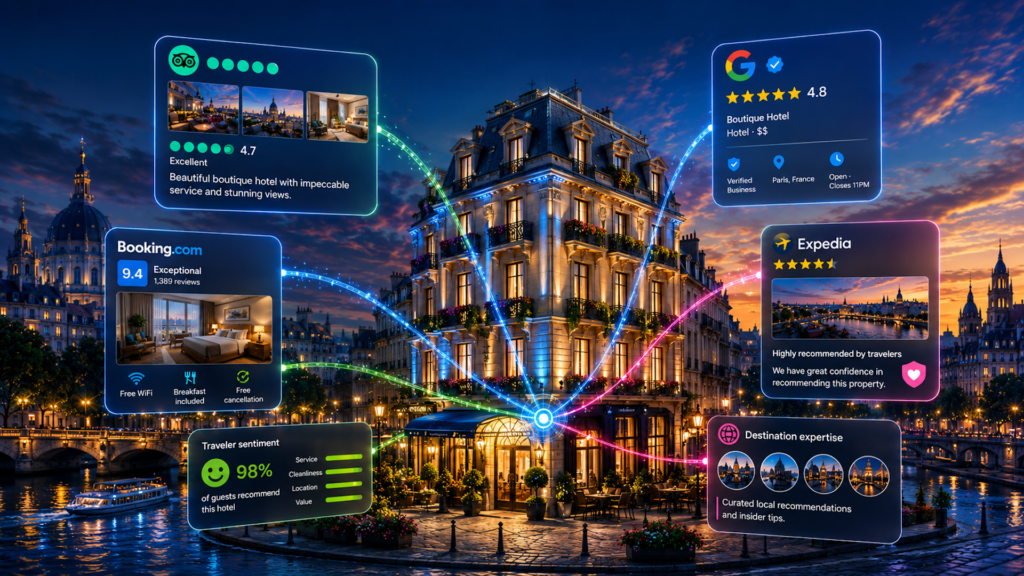
AI Overviews synthesize information from multiple sources and present users with curated recommendations rather than a collection of links. As a result, trust, consistency, and contextual understanding become critical visibility factors.
A hotel may influence a traveler’s decision through an AI-generated response without leading to an immediate website visit. The traveler’s next action may be a branded search, a visit to a travel review site, or a booking through an online travel agency (OTA).
To earn recommendations from AI models, your brand first needs to be clearly defined. AI must have confidence in who you are, what you offer, who you serve, and when your brand is relevant.
To do this, choose one primary category and one clear position for your brand. Invest in digital PR and earn mentions beyond your own website. Aim to…
Source link
Disclaimer
We strive to uphold the highest ethical standards in all of our reporting and coverage. We blogs.grocliq.com want to be transparent with our readers about any potential conflicts of interest that may arise in our work. It’s possible that some of the investors we feature may have connections to other businesses, including competitors or companies we write about. However, we want to assure our readers that this will not have any impact on the integrity or impartiality of our reporting. We are committed to delivering accurate, unbiased news and information to our audience, and we will continue to uphold our ethics and principles in all of our work. Thank you for your trust and support.
Website Upgradation is going on for any glitch kindly connect at [email protected]