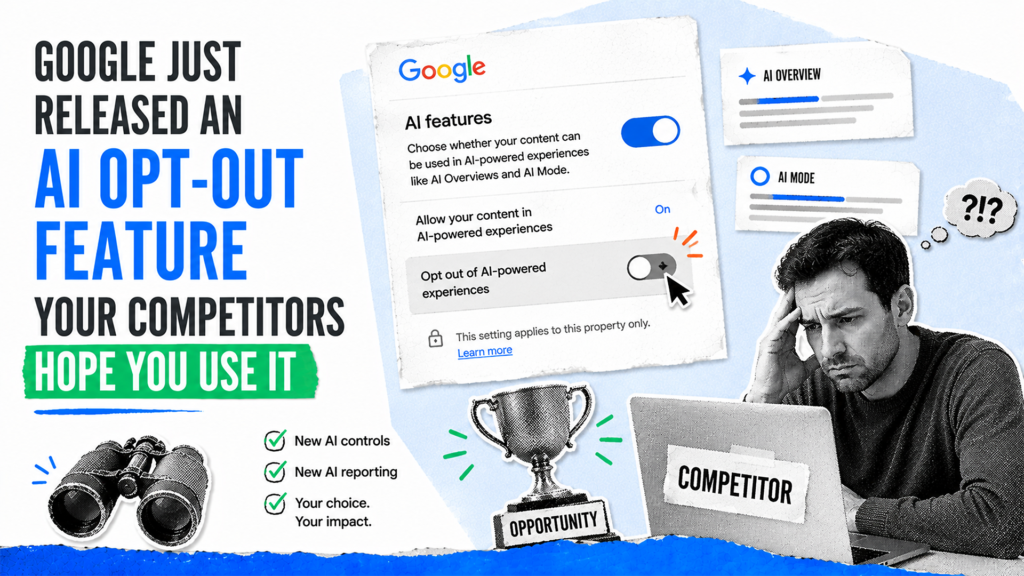

For the past two years, the SEO industry has been asking Google for two things: more visibility into AI traffic and more control over how content appears in AI experiences.
Last week, Google started delivering both.
They announced new controls that allow site owners to opt out of AI-powered experiences (AI Overviews, AI Mode, etc.) and introduced new AI reporting within Google Search Console. (Note that both of these are in early beta and are not yet available for everyone.)
On paper, this is a victory for things moving in the right direction for publishers.
Instead, the conversation immediately split into camps. Some focused on the new reporting. Others focused on the new controls and began debating whether to opt out of AI altogether.
What caught my attention wasn’t the announcement itself. It was how quickly the conversation shifted from gaining visibility to voluntarily giving it up.
What this actually means
Before we go any further, let’s clear up what Google actually announced.
The new controls do not turn off AI Overviews, stop people from using AI Mode, or slow AI adoption. Users are still going to search and ask questions, and increasingly do so through AI-powered experiences.
Google introduced a way for publishers to have more control over whether their content can be surfaced in those experiences. (Was this the plan all along, or was it exclusively because of the UK Competition and Markets Authority demanding it?)

That’s an important distinction because many people are treating this as a decision about AI itself. It isn’t.
- AI Mode doesn’t disappear because a publisher opts out.
- AI Overviews don’t disappear when a website decides not to participate.
The user experience remains largely unchanged. The only thing that changes is which brands are eligible to appear.
If Expedia opted out tomorrow, people wouldn’t stop planning vacations. If NerdWallet opted out tomorrow (like I did their stock), people wouldn’t stop researching credit cards. Google would simply surface someone else in its place.
This isn’t a decision about whether AI succeeds or fails. It’s a decision about whether your brand is present when customers choose to use it.
Why AI opt-out sounds good but is actually a trap
I understand the appeal. Publishers are worried about losing more clicks, frustrated by changing search behavior, and concerned about how AI systems use their content.
Those concerns are beyond valid.
Where I disagree is with the assumption that opting out changes user behavior.
It doesn’t.
Users aren’t deciding whether to use AI based on your participation. They’re deciding whether AI helps them get answers faster. For a growing number of searches, it does.
That’s why opting out of AI inclusion and opting users out of AI experiences are two different things.
A publisher can choose not to participate….
Source link
Disclaimer
We strive to uphold the highest ethical standards in all of our reporting and coverage. We blogs.grocliq.com want to be transparent with our readers about any potential conflicts of interest that may arise in our work. It’s possible that some of the investors we feature may have connections to other businesses, including competitors or companies we write about. However, we want to assure our readers that this will not have any impact on the integrity or impartiality of our reporting. We are committed to delivering accurate, unbiased news and information to our audience, and we will continue to uphold our ethics and principles in all of our work. Thank you for your trust and support.
Website Upgradation is going on for any glitch kindly connect at [email protected]