
This series began with an observation: AI systems don’t always give the same answer to the same question. In the first article, I argued that the inconsistency wasn’t randomness. It was confidence loss across a measurable pipeline we can diagnose and fix.
Working through the AI engine pipeline, gate by gate, eventually led me to the won gate, where three clicks await: the imperfect click of search, the perfect click of recommendations, and the agentic click of agents.
That’s where I realized the series couldn’t stay within marketing. When an agent makes the purchase, it becomes a client you need to satisfy directly.
The funnel now runs through a machine that plugs into the business itself. SEO has no choice: it becomes assistive agent optimization, part of how the entire business is engineered.
To understand why, it helps to see how the underlying concepts fit together.
The framework is the theory. It explains why AI systems make the decisions they make and what influences those decisions. Apply those principles across the business, and you get AI-era business engineering: a company organized so search engines, AI assistants, agents, and people can all find you, understand you, recommend you, and buy from you.
Everything builds on SEO
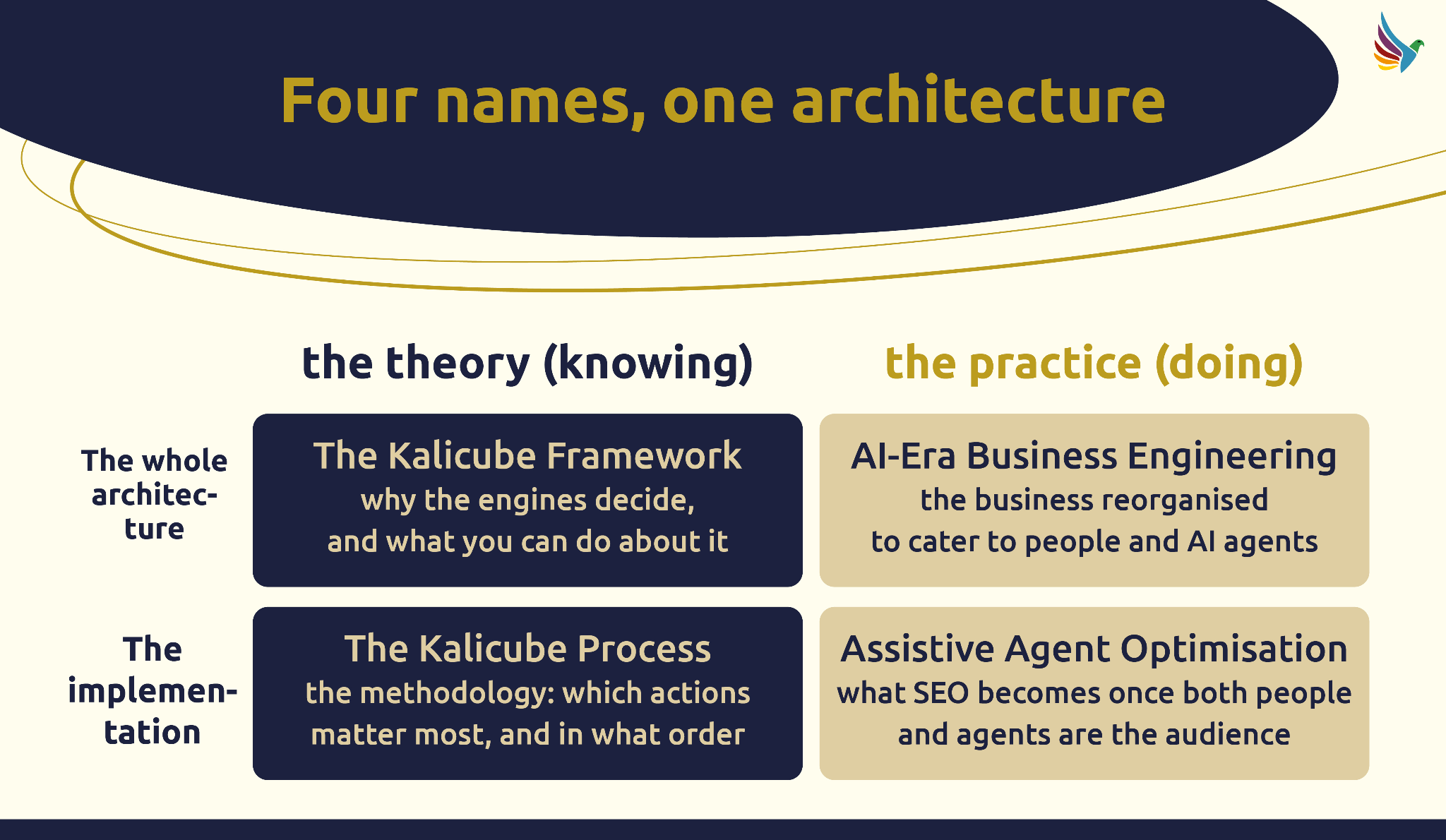
The process is the day-to-day methodology. It sits above your existing disciplines — SEO, content, PR, paid media, and digital marketing — helping you prioritize the actions that have the greatest impact on recommendations and visibility.
Here’s the part every SEO should appreciate: assistive agent optimization is built on SEO. It doesn’t replace it.
Picture a Russian doll. SEO sits at the center. It draws from the open web, the same crawled and indexed foundation search has always relied on.
At that core are two parts of the algorithmic trinity: the search engine, which indexes and ranks information, and the knowledge graph, which stores entities and the relationships between them.
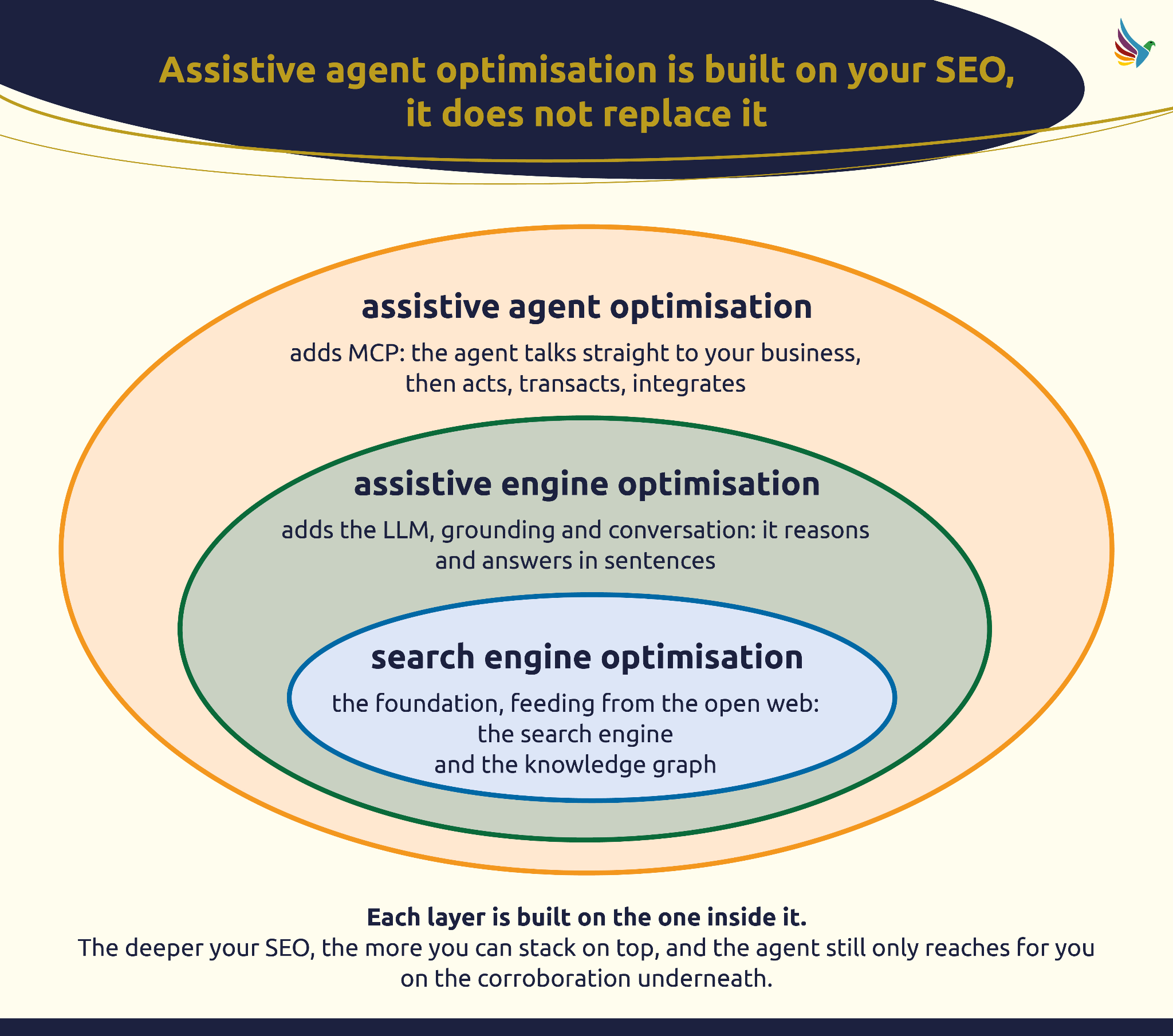
The next layer is assistive engine optimization. It adds the third component of the trinity: the large language model. The LLM provides reasoning, grounding, and conversation.
Instead of returning a list of links, it evaluates corroborating evidence and responds directly to the user. This layer builds on traditional SEO with entity corroboration, machine-readable proof, and the signals that help AI systems understand what your content means.
The outer layer is the agent. It introduces something the layers beneath it never had: direct access to business systems through protocols such as MCP. An agent can check inventory, compare prices, and complete transactions without visiting a page or navigating a search result. This is where AI stops recommending and starts acting.
Each layer depends on the one beneath it. The stronger your SEO foundation, the more effectively you can build everything above it. That makes SEO more central to digital marketing — and to the…
Source link
Disclaimer
We strive to uphold the highest ethical standards in all of our reporting and coverage. We blogs.grocliq.com want to be transparent with our readers about any potential conflicts of interest that may arise in our work. It’s possible that some of the investors we feature may have connections to other businesses, including competitors or companies we write about. However, we want to assure our readers that this will not have any impact on the integrity or impartiality of our reporting. We are committed to delivering accurate, unbiased news and information to our audience, and we will continue to uphold our ethics and principles in all of our work. Thank you for your trust and support.
Website Upgradation is going on for any glitch kindly connect at [email protected]