

Note: This article was originally published on Reasoned and is being cross-posted on MediaNama. Read the original version here: [link].
The tension between the need to deploy, the complexity and the need for flexibility
Why aren’t we seeing mass deployment of agents in enterprises, across functions?
A manufacturing company founder I know has a simple thesis for deploying agents in his company: when you need information, analysis or research, people in the loop can often become constraints: in an organisations that has thousands of employees and customers across jurisdictions, it can take time to pull out data, prepare reports, and deliver information to act upon.
Interoperability allows an agent to pull information from various sources, whether the ERP, inventory management systems, management information systems, sales, HR and finance, and give reviews and recommendations, create dashboards, and help speed up decision making for business owners. Nobody cares about which model is being used or which harness: they just have jobs to be done.
I’ve noticed that while founders are at present empowered to deploy agents for themselves: organisations themselves have lower risk-taking capacity.
Still, enterprise adoption of AI agents remains slow, and three talks at SuperAI, from Snowflake, Alibaba Cloud and Sierra highlighted some challenges and offered some solutions:
1. It’s all about the harness: Harshil Mathur, CEO of Razorpay said on x recently that businesses will either be the model or the harness. AI models have crossed a capability threshold for reasoning, tool calling, and large context, but the harness is where the complexity lies.
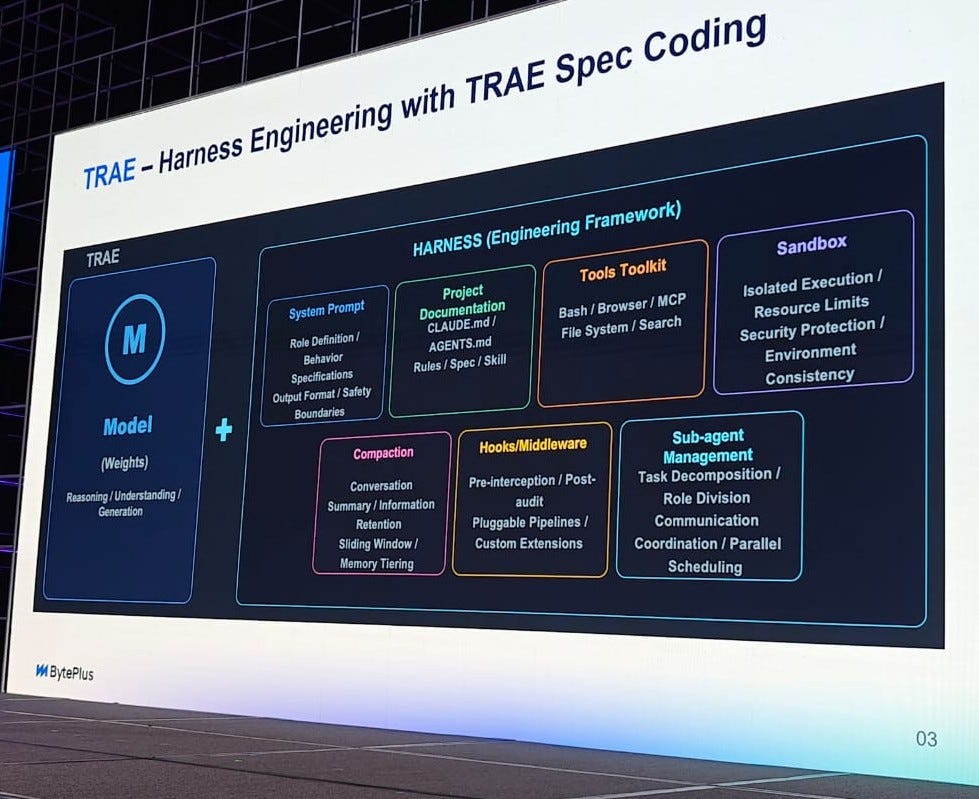
The harness is everything around the model that controls its behaviour, and while definitions of harness vary, it includes everything from what an Agents’ soul.md contains, the tenets it has, the skills it uses creates and improves, how it responds to user requests, what tools it invokes, how it connects. It’s why, for the same model, Claude Code works differently from Opencode: the constraints vary.
When Alibaba Cloud’s Ken Xu sits down with enterprise customers, the conversation is never about the model, he said at SuperAI:
“The bottleneck is no longer can the model do it or not. The bottleneck is can the enterprise put it into production safely. That’s an architecture and harness problem, not the model problem anymore.”
“When you build your own agent, you’re not just calling the large language model. You are building a runtime that execute multiple task plans, a memory system that survive across sessions. A tool layer that touches your production data, governance for compliance, and observability to debug what the agents actually did.”
He framed it as “agents as a system, not a feature”, and frankly the challenge lies in the production stack, the organisational readiness, how agents deal with customers speaking in three languages…
Source link
Disclaimer
We strive to uphold the highest ethical standards in all of our reporting and coverage. We blogs.grocliq.com want to be transparent with our readers about any potential conflicts of interest that may arise in our work. It’s possible that some of the investors we feature may have connections to other businesses, including competitors or companies we write about. However, we want to assure our readers that this will not have any impact on the integrity or impartiality of our reporting. We are committed to delivering accurate, unbiased news and information to our audience, and we will continue to uphold our ethics and principles in all of our work. Thank you for your trust and support.
Website Upgradation is going on for any glitch kindly connect at [email protected]