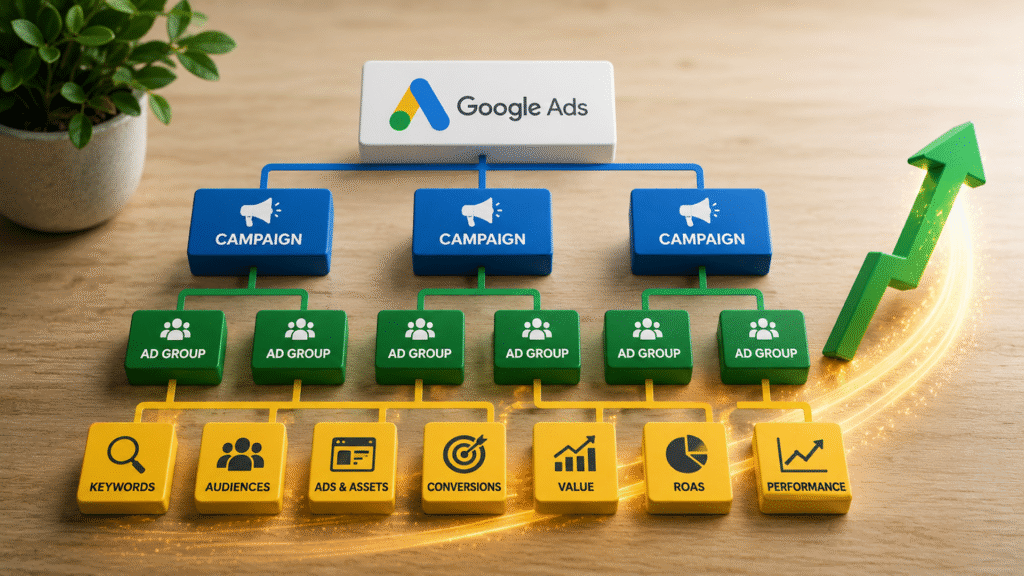

Most Google Ads audits focus on the obvious: keywords, bids, ad copy, and Quality Scores. But one of the most significant — and most overlooked — performance barriers isn’t a setting you can find in a single campaign tab. It’s how the account is structured in the first place.
Campaign structure determines how Google’s machine learning interprets your data, how budget flows across your goals, and whether your data gets collected in one place or scattered across too many campaigns. Get it wrong, and you’re not just leaving performance on the table — you’re actively working against the algorithms you’re paying to optimize for.
Here’s how campaign structure affects performance across standard Search campaigns, Performance Max, and Smart Bidding, and what you can do about it.
How campaign structure shapes Google’s learning
Many advertisers treat campaign structure as a matter of tidiness: neatly sorted ad groups, logical naming conventions, and campaigns carved up by product line or geography. But to Google’s systems, structure means something else entirely.
Every campaign is a data container. The way you segment campaigns determines what signals Google pools together to make bidding and targeting decisions. A scattered structure means scattered learning, which leads to slower, less accurate optimization.
Google’s Smart Bidding and automation work better with more data concentrated in fewer campaigns. The algorithm needs volume — typically 30 to 50 conversions per campaign per month — to exit the learning phase and make reliable predictions. A structure that disperses conversions across too many campaigns starves each one of the data it needs to perform.
A common scenario: An ecommerce account has 12 separate Search campaigns, one for each product category. Each campaign averages 8-12 conversions per month. Smart Bidding is enabled across all of them, but none consistently exit the learning phase.
The fix is consolidation.
See exactly how your competitors win.
Uncover the keywords, ads, landing pages, and strategies driving your competitors’ paid search success—and find your next opportunity to outperform them.
Analyze your competitors
Over-segmentation breaks Smart Bidding
Smart Bidding strategies — Target CPA, Target ROAS, Maximize Conversions, and Maximize Conversion Value — rely on real-time signals: device, location, time of day, audience, search query, and more. Google weighs these signals together to predict which auctions are worth winning and at what price.
When campaigns are over-segmented, several problems can occur:
- Insufficient conversion volume: Each campaign operates below the threshold Google needs to make confident bidding decisions, leading to unstable CPAs and CPCs.
- Extended learning phases: Every budget change, bid strategy switch, or structural edit…
Source link
Disclaimer
We strive to uphold the highest ethical standards in all of our reporting and coverage. We blogs.grocliq.com want to be transparent with our readers about any potential conflicts of interest that may arise in our work. It’s possible that some of the investors we feature may have connections to other businesses, including competitors or companies we write about. However, we want to assure our readers that this will not have any impact on the integrity or impartiality of our reporting. We are committed to delivering accurate, unbiased news and information to our audience, and we will continue to uphold our ethics and principles in all of our work. Thank you for your trust and support.
Website Upgradation is going on for any glitch kindly connect at [email protected]