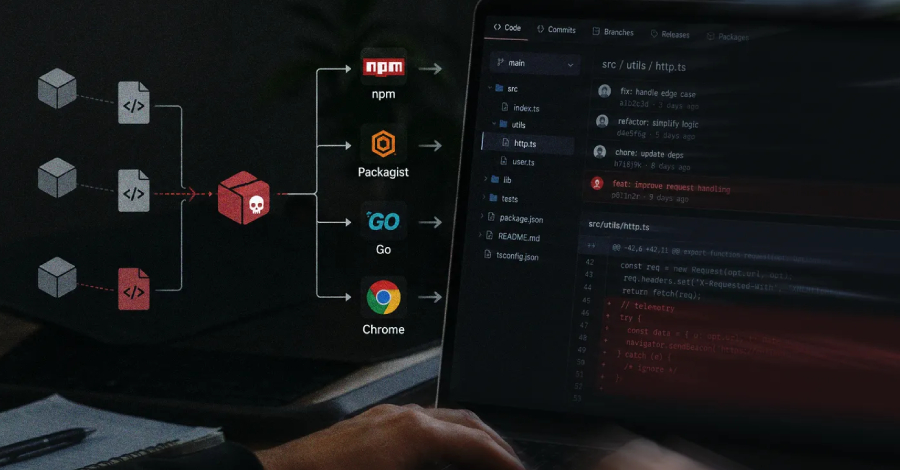


The North Korean threat actors linked to the Contagious Interview campaign have been observed publishing 108 unique packages and web browser extensions spanning npm, Packagist, Go, and Google Chrome as part of an ongoing activity referred to as PolinRider.
“The campaign remains active, and new malicious packages are likely to continue appearing as threat actors compromise maintainer accounts, modify legitimate repositories, and publish infected package versions where they retain or obtain registry access,” Socket security researcher Karlo Zanki said in an analysis published this week.
The 162 malicious release artifacts span multiple release versions corresponding to 108 unique packages and extensions, including 19 npm libraries, 10 Composer packages, 61 Go modules, and one Google Chrome extension.
Contagious Interview is the moniker assigned to a North Korea-aligned campaign that weaponizes job recruitment to target software developers and individuals working in the cryptocurrency sectors, using persuasive job interviews and assessments to trick them into executing malicious code.
The activity is known to be active since at least 2023. Attackers masquerade as recruiters or collaborators on platforms like LinkedIn, GitHub, or freelance websites, often setting up elaborate front companies and AI-generated employee profiles to build trust and ultimately deliver malware.
PolinRider was first flagged by the OpenSourceMalware team in March 2026, describing it as involving the threat actors implanting malicious obfuscated JavaScript payloads in hundreds of public GitHub repositories belonging to several unique owners to deliver a new variant of BeaverTail, a known JavaScript malware associated with Contagious Interview.
As of April 11, 2026, the activity has compromised 1,951 public GitHub repositories associated with 1,047 unique owners, while also merging with another cluster called TaskJacker that drops malicious VS Code task files into GitHub users’ existing repositories. The VS Code tasks include the “runOn: ‘folderOpen'” option to trigger the execution of arbitrary code when the folder is opened as a workspace folder in an IDE like VS Code or Cursor.
“The threat actor is not using stolen GitHub credentials,” OpenSourceMalware said. “Instead, the victims have been compromised via a malicious VS Code extension or npm package.” It’s believed that the attackers are taking over maintainer accounts, likely through expired domain takeover or another account recovery path, to pull off the scheme.
Once executed, the malware searches the infected computer for certain files like “postcss.config.mjs,” “tailwind.config.js,” “eslint.config.mjs,” next.config.mjs,” babel.config.js,” and “app.js,” and, if found, appends malicious JavaScript code to them.
It also makes use of a Windows batch script to stealthily modify the last commit, while making it appear as if they were made by the original author. It’s suspected that similar tools are being…
Source link
Disclaimer
We strive to uphold the highest ethical standards in all of our reporting and coverage. We blogs.grocliq.com want to be transparent with our readers about any potential conflicts of interest that may arise in our work. It’s possible that some of the investors we feature may have connections to other businesses, including competitors or companies we write about. However, we want to assure our readers that this will not have any impact on the integrity or impartiality of our reporting. We are committed to delivering accurate, unbiased news and information to our audience, and we will continue to uphold our ethics and principles in all of our work. Thank you for your trust and support.
Website Upgradation is going on for any glitch kindly connect at [email protected]