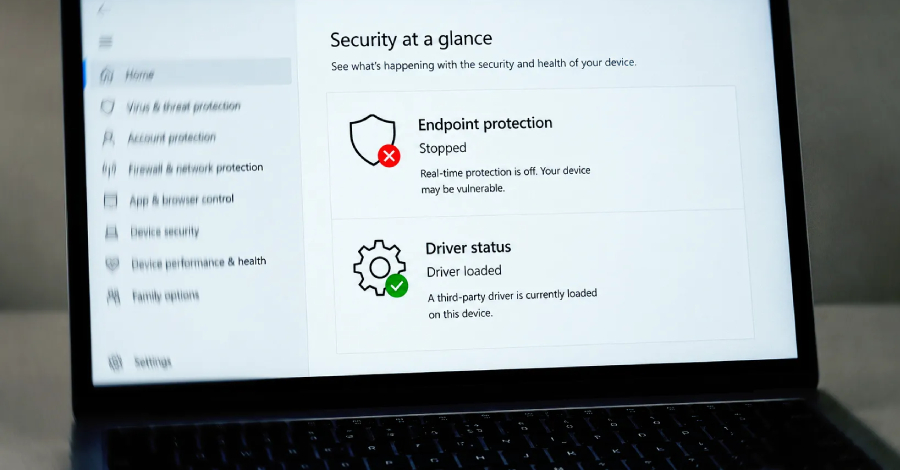


Cybersecurity researchers have flagged a new ransomware family called GodDamn that employs the PoisonX kernel driver to neutralize security software as part of its defense evasion strategy.
According to a new report published by the Threat Hunter Team from Symantec, the ransomware was first publicly spotted in the wild on May 21, 2026. It’s assessed to be a rebrand of the Beast ransomware, which, in turn, was an enhanced version of Monster, a Delphi-based ransomware that surfaced in March 2022. Broadcom’s cybersecurity arm is tracing the developer behind these ransomware families under the moniker Hyadina.
In one attack orchestrated by the ransomware operation in early June 2026, the threat actors are said to have leveraged AnyDesk for remote access and used a NirSoft-based credential harvesting toolkit before deploying the ransomware. The exact initial access vector is unknown. The credential harvester is designed to extract sensitive data from common web browsers, Windows Credential Manager, cached domain credentials, VNC sessions, email clients, Wi-Fi profiles, and live network traffic.
Also put to use in the attack is a user-mode defense evasion tool that’s dressed as a Symantec product (“symantec.exe”) and the PoisonX kernel driver (“g11.sys”) to disable endpoint defenses in what’s called a bring your own vulnerable driver (BYOVD) attack.
“However, the PoisonX driver seems to be slightly more unusual, in that it appears to be a malicious driver that its developers succeeded in getting signed by Microsoft, and it is now being used by ransomware attackers,” the Symantec Threat Hunter Team said in a report shared with The Hacker News.
It’s worth noting that PoisonX is one of the eight drivers adopted by the operators of The Gentlemen ransomware-as-a-service (RaaS) scheme in its custom GentleKiller tool that it hands out to affiliates for impairing system defenses prior to executing the encryptor.
“Vulnerable drivers are the attacker’s most reliable route in,” Broadcom noted last month. “The attacker, having gained administrator privileges, can drop a flawed but validly signed driver onto the target machine. Because the driver is signed, Windows loads it automatically.”
“The most common action is to kill the processes belonging to antivirus (AV) or endpoint detection and response (EDR) products, stripping the machine of its defenses. Some variants are more subtle. Attackers may strip the security agent of the rights it needs to function correctly, leaving it running but unable to act. Others tamper directly with the kernel’s internal records so that the security product no longer receives notifications about what is happening on the machine, effectively making it blind.”
The attack is also characterized by the use of PsExec to facilitate lateral movement, followed by setting up AnyDesk on each of those reachable hosts and registering it as an auto-start Windows service to…
Source link
Disclaimer
We strive to uphold the highest ethical standards in all of our reporting and coverage. We blogs.grocliq.com want to be transparent with our readers about any potential conflicts of interest that may arise in our work. It’s possible that some of the investors we feature may have connections to other businesses, including competitors or companies we write about. However, we want to assure our readers that this will not have any impact on the integrity or impartiality of our reporting. We are committed to delivering accurate, unbiased news and information to our audience, and we will continue to uphold our ethics and principles in all of our work. Thank you for your trust and support.
Website Upgradation is going on for any glitch kindly connect at [email protected]