

Researchers at firmware security firm Binarly have found six new flaws in U-Boot, the small program that starts up hardware as varied as home routers, smart cameras, and the management chips inside data-center servers.
Four of the bugs can crash a device. The other two could let an attacker who slips a malicious image in front of the bootloader run their own code, before the device has confirmed that the software is genuine.
That last part is the point. A bootloader runs before the operating system, so a flaw here can undermine everything that loads after it. All six bugs are reached while U-Boot is still reading an untrusted image, before it has checked the signature.
What Binarly found
U-Boot can bundle a kernel, device tree, ramdisk, and other boot components into one package, a FIT (Flattened Image Tree), and it checks that package’s digital signature before handing over control.
Binarly went looking for weak spots in that check and found six. Most of the vulnerable code has been in U-Boot since v2013.07, Binarly says, across more than 50 stable releases, and it also lives in the many vendor firmwares built on top of U-Boot.
The bugs are tracked as Binarly advisories BRLY-2026-037 through BRLY-2026-042. No CVE identifiers have been assigned yet. They fall into two groups: two that could run code, and four that only crash.
The two are BRLY-2026-037 and BRLY-2026-038, and both trace to one unchecked value. U-Boot calls fdt_get_name, a lookup in the device-tree parsing library it borrows, and on a malformed image, that lookup returns a null pointer and a negative length. U-Boot uses both without checking either.
One bug follows the null pointer into a memory copy that, on devices where address zero is mapped, becomes a stack buffer overflow. The other feeds the negative length into pointer arithmetic that walks backward until it overwrites a saved return address. In the right memory layout, either one can hand control to code the attacker-supplied.
The other four only crash the bootloader. BRLY-2026-039 and BRLY-2026-041 read past the end of the image by trusting a size or offset that the attacker controls. BRLY-2026-040 dereferences a null pointer that an older image format hands back unchecked. BRLY-2026-042 exhausts the stack, set off by a deeply nested image that drives an early validation step to call itself until it runs out.
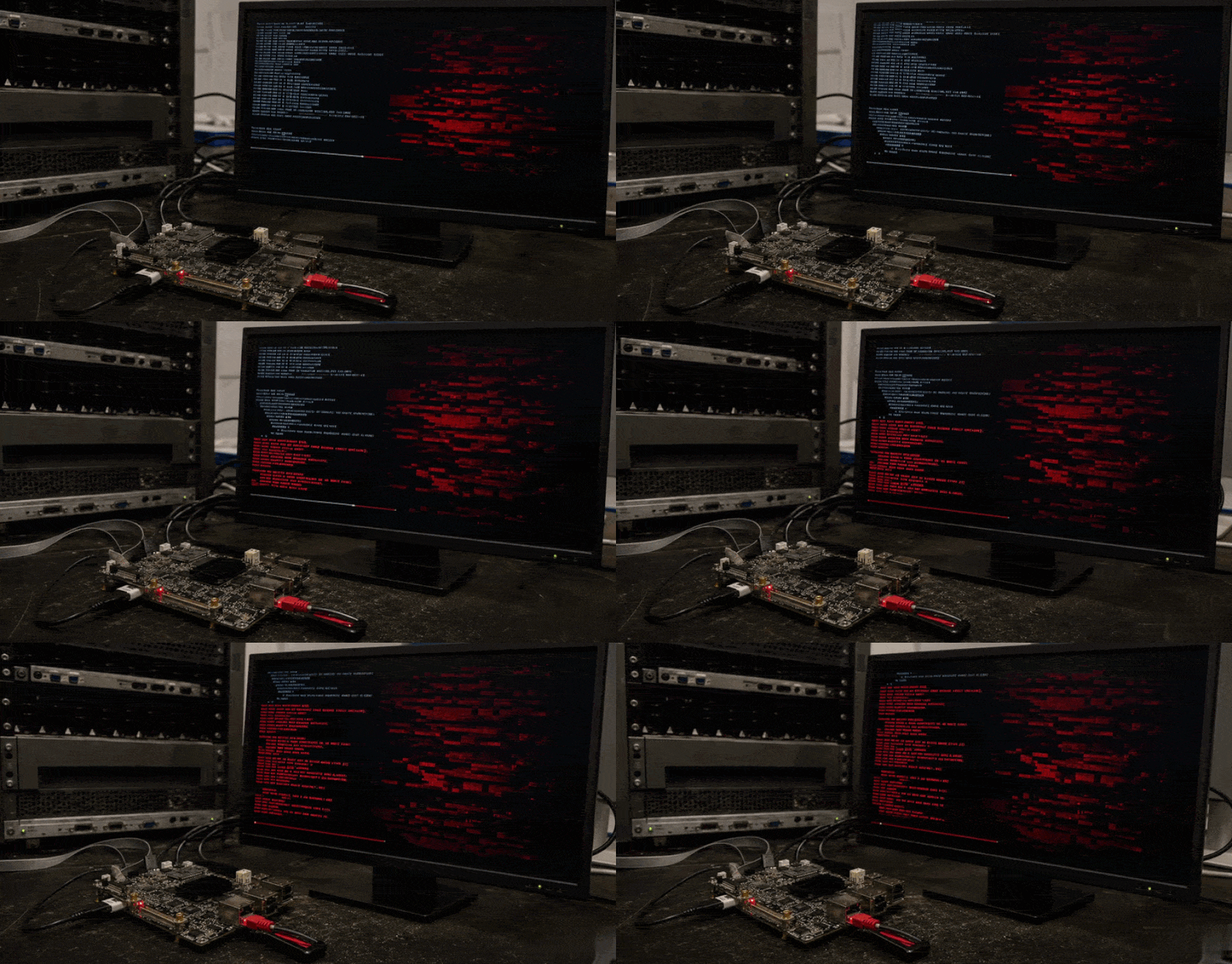
Binarly published a proof-of-concept image and reproduction steps for each flaw and demonstrated them against standard U-Boot builds. No exploitation in real attacks has been reported.
Of the six, the two memory-corruption bugs are the ones to prioritize: a crash can knock a device offline, but code execution at boot could subvert its entire chain of trust.
How bad it gets
In the worst case, recovering a device that will not boot means physical access and reflashing its memory chip with a clean image. Code execution is worse. Code that runs this early sits below the operating…
Source link
Disclaimer
We strive to uphold the highest ethical standards in all of our reporting and coverage. We blogs.grocliq.com want to be transparent with our readers about any potential conflicts of interest that may arise in our work. It’s possible that some of the investors we feature may have connections to other businesses, including competitors or companies we write about. However, we want to assure our readers that this will not have any impact on the integrity or impartiality of our reporting. We are committed to delivering accurate, unbiased news and information to our audience, and we will continue to uphold our ethics and principles in all of our work. Thank you for your trust and support.
Website Upgradation is going on for any glitch kindly connect at [email protected]