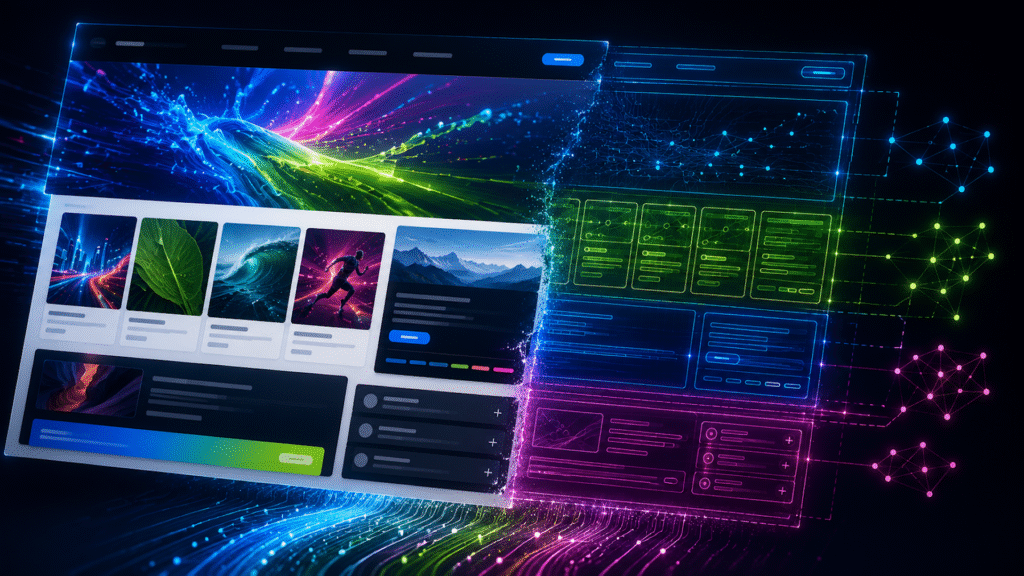

SEO has long focused on what a page says. Increasingly, it also needs to account for how that information is presented.
As Google gets better at understanding page layout, structure, and functionality, visual semantics is becoming an important part of how search engines interpret webpages.
What is visual semantics?
Visual semantics is a meaning model for segmenting, classifying, and understanding documents by working alongside textual semantics.
Google is changing how it interprets web documents, shifting from “web text” to “web layout” to better identify real expertise, uniqueness, and originality by giving more weight to the functional components of a webpage.
Google’s Quality Rater Guidelines cite “human effort and involvement” as one of the most important quality principles, with “design effort” identified as one aspect of that evaluation.
Webpage layout has always been an important part of SEO, dating back to Google’s Page Layout algorithms. Those early algorithms focused primarily on ad placement and simple document-ranking signals, unlike today’s more sophisticated approaches to understanding webpages.
Be the brand customers find first.
Track, grow, and measure your visibility across Google, AI search, social, local, and every channel that influences buying decisions.
Start your free trial
Why Google is paying more attention to page layout
Google has introduced newer inventions and patents that highlight the importance of understanding webpage layout. Most webpages are no longer built with only prose or simple text-over-text layouts. Instead, they contain much denser information.
Every 10 to 20 pixels can introduce a new interaction point, engagement element, clickable module, comparison unit, or dynamic component designed to help users.
That’s why some of Google’s leading engineers, including those who have worked on Gemini and AI Mode, are also associated with newer inventions such as Structured Information Cards and layout-aware multimodal document understanding.
Below is a direct citation from Google’s work on structured information cards and layout-aware multimodal document understanding. Google often finds important information within interactive card structures rather than ordinary paragraphs.
As a result, it needs systems that can understand how different card types are structured, including product cards, hotel cards, real estate cards, trip cards, credit card cards, and other information cards.
In other words, modern search engines must understand not only the text on a page but also the layout, hierarchy, visual relationships, annotations, and functional meaning of each structured information block.

Why layout matters for search engines
Understanding…
Source link
Disclaimer
We strive to uphold the highest ethical standards in all of our reporting and coverage. We blogs.grocliq.com want to be transparent with our readers about any potential conflicts of interest that may arise in our work. It’s possible that some of the investors we feature may have connections to other businesses, including competitors or companies we write about. However, we want to assure our readers that this will not have any impact on the integrity or impartiality of our reporting. We are committed to delivering accurate, unbiased news and information to our audience, and we will continue to uphold our ethics and principles in all of our work. Thank you for your trust and support.
Website Upgradation is going on for any glitch kindly connect at [email protected]