The next mass frontier of AI is agentic:
To figure out how ready B2B sites are for agentic visitors, I teamed up with David Kaufman, founder of Siteline, and I analyzed how agents scan websites and where they get stuck. The answer: most sites are agent-ready, but there is one critical breaking point.
Agents don’t read websites like humans. They receive a task, search the web, fetch pages, extract facts, and cite the sources they used. A page can persuade a human and still fail an agent if the facts are hard to find (opacity), hard to fetch (machine-readability), or hard to cite (access friction).
AI agents turn websites from showrooms into barcodes.
How we looked at agent behavior:
- The agent had to find the official site itself. We did not provide starting links, eg to homepages.
- We gave agents three buyer-related tasks for 100 B2B products: find pricing/features, integrations, and security/compliance. We ran each task five times to measure the impact of the probabilistic nature of LLMs.
- We weren’t comparing whether or not the information existed somewhere on the web; instead, we measured whether the agent could reliably answer from the vendor’s own site.
1. Pricing breaks first-party sites
The moment a prospect looks at pricing, they stop browsing and start comparing. High buyer intent, bottom of the funnel. That makes pricing the hardest and most important test of whether a vendor site can serve agents directly.
Pricing also sits in a triangle of 3 “wants” that good pricing pages need to satisfy:
- Companies want to control pricing disclosure.
- Buyers want fast comparison.
- Agents need clear, fetchable, citable facts.
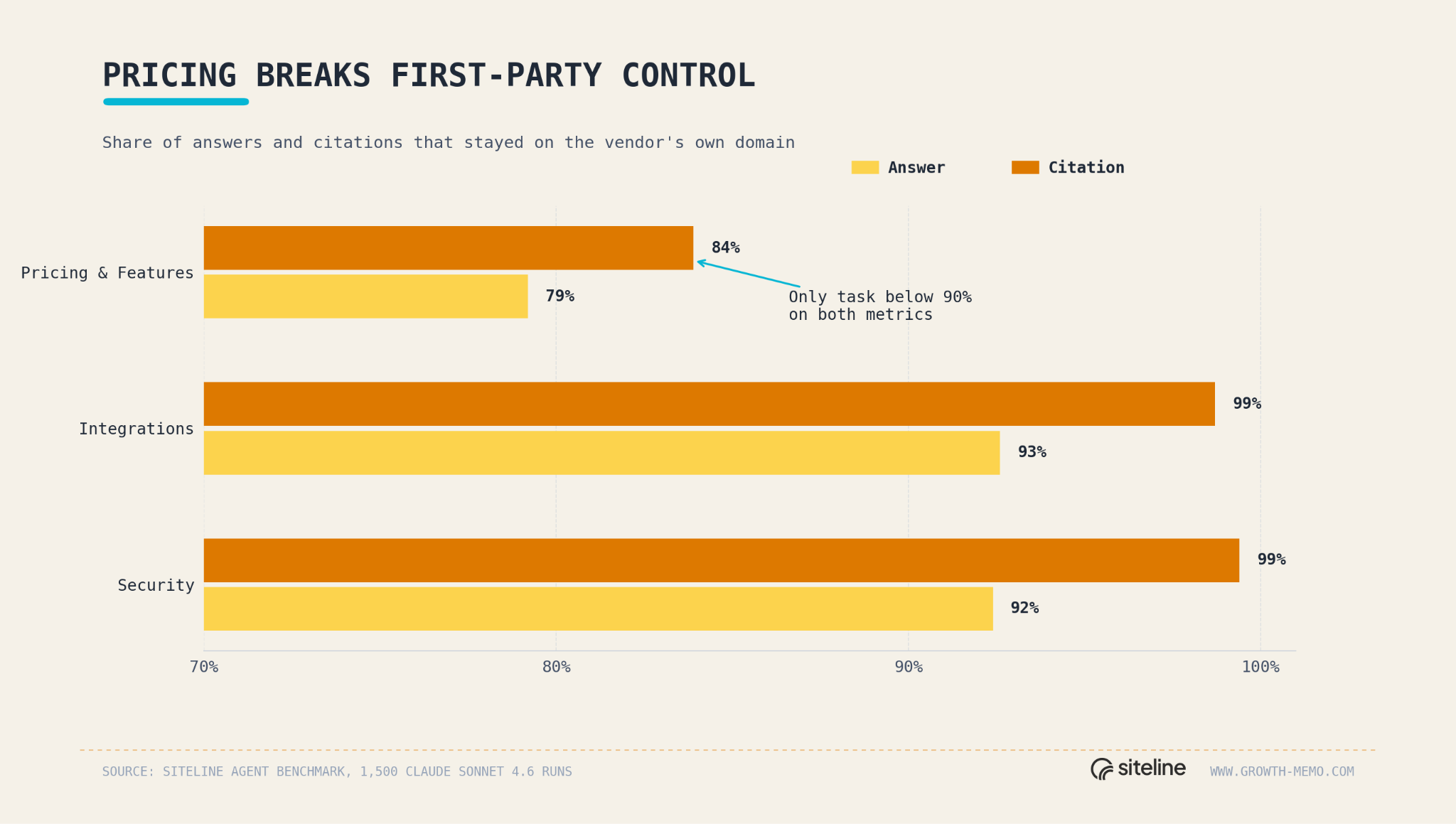
When AI agents try to retrieve pricing, they get stuck much more than for security or integrations.
- Pricing/features: 79% first-party answer rate, 84% first-party citation share.
- Integrations: 93% and 99%.
- Security: 92% and 99%.
- Pricing/features produced 77% of all third-party citations.
If you wonder whether that’s because some B2B companies don’t publicly show pricing, you’re only half right.
2. Hidden pricing is only part of it
Hiding prices forces agents to look elsewhere, but published prices do not fully solve the problem. Among pricing prompt runs where the vendor did not disclose a real price, 45% cited at least one third-party source. The other 55% stayed on first-party citations, usually by saying the vendor required contact sales or did not publish a concrete price.
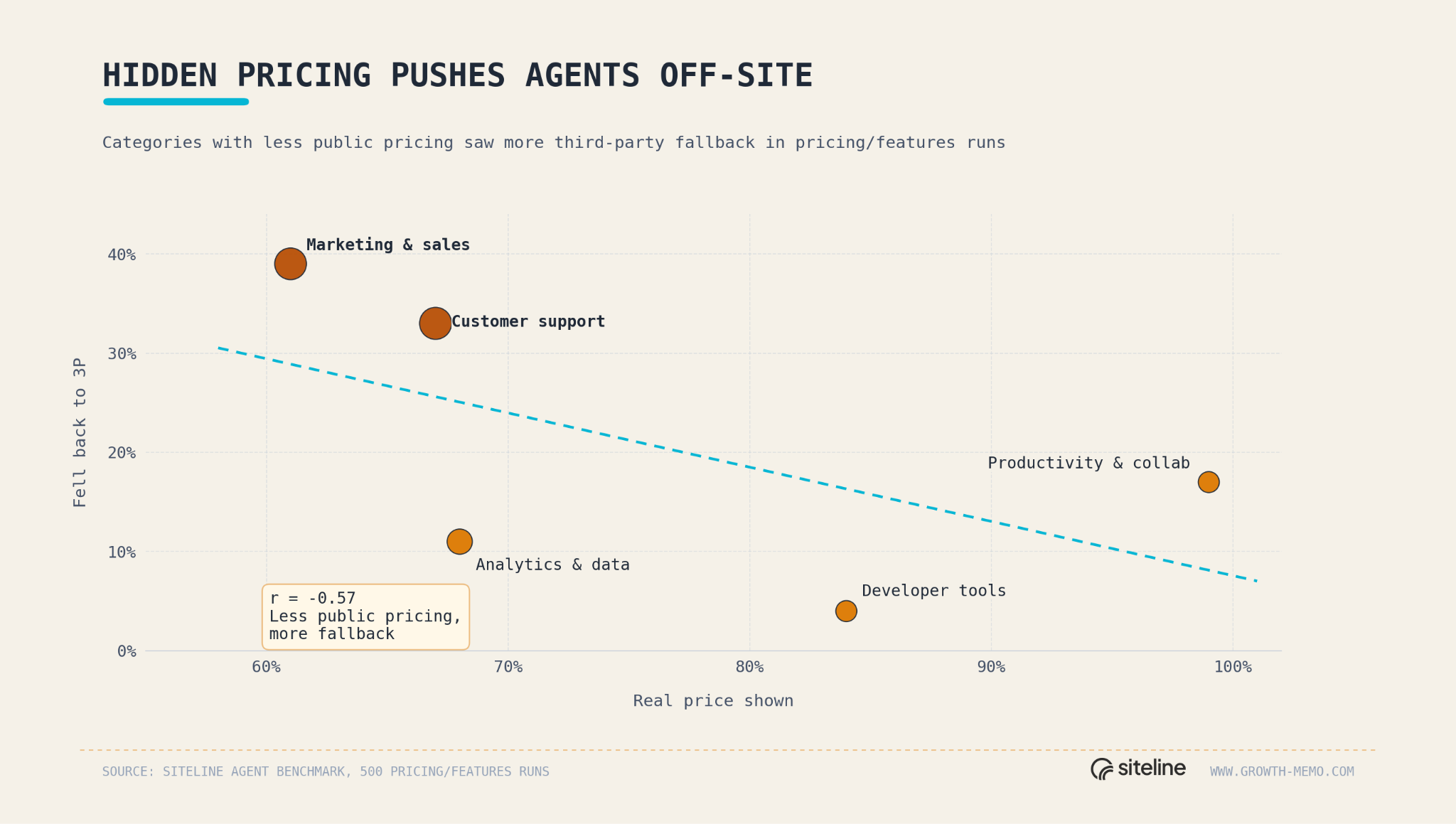
Even when the vendor showed a numeric public price, agents still cited at least one third-party source in 18% of runs, suggesting price can be on the page but still be hard for the agent to extract, trust, or cite cleanly.
You can try to hide your pricing, but you better make sure no one else knows and writes about it. Once it’s “out there”, it’s too late. If you have complex pricing methodology, the best way is to explain it clearly and make…
Source link
Disclaimer
We strive to uphold the highest ethical standards in all of our reporting and coverage. We blogs.grocliq.com want to be transparent with our readers about any potential conflicts of interest that may arise in our work. It’s possible that some of the investors we feature may have connections to other businesses, including competitors or companies we write about. However, we want to assure our readers that this will not have any impact on the integrity or impartiality of our reporting. We are committed to delivering accurate, unbiased news and information to our audience, and we will continue to uphold our ethics and principles in all of our work. Thank you for your trust and support.
Website Upgradation is going on for any glitch kindly connect at [email protected]