
Adding FAQ sections to a set of test pages lifted AI citations. Removing them dropped citations back down.
That reversion is the difference between correlation and causation, and almost no team measuring AI search today can produce it.
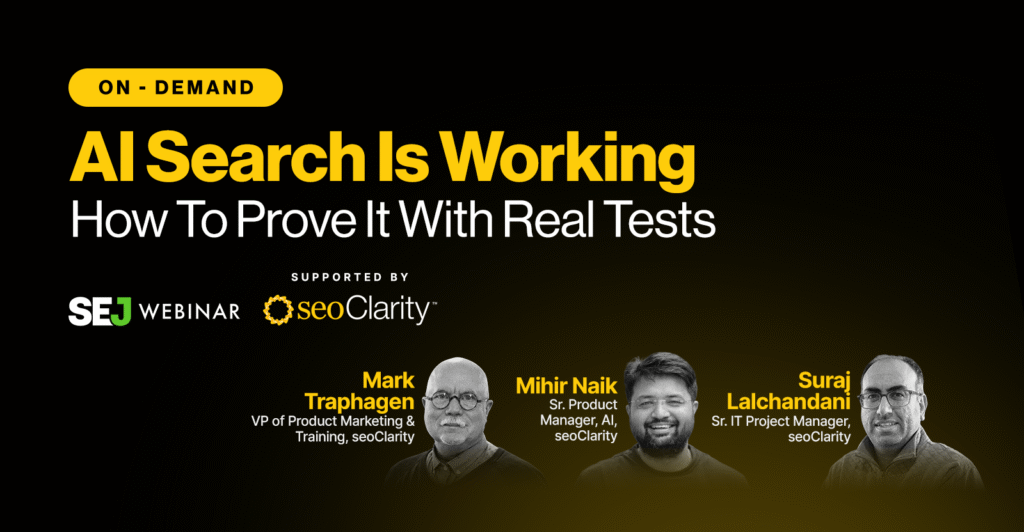
That standard of proof anchored the latest SEJ webinar with seoClarity’s Mark Traphagen, VP of Product Marketing & Training, Mihir Naik, Senior Product Manager, AI, and Suraj Lalchandani, Sr. IT Project Manager. Their core argument: “Visibility scores tell you if you showed up. Page-level performance and split testing tell you if what you did actually mattered.”
The session walked through the split testing methodology seoClarity’s enterprise clients run across ChatGPT, Claude, Perplexity, Gemini, and Google’s AI surfaces: how to build a funnel-spanning golden set of prompts, how to construct a control group when LLMs will not let you A/B test, and where Google’s new first-party Search Console AI data fits.
They also shared results from three real client tests, including the one change that moved citations and two results nobody in the room predicted.
Watch the full webinar on demand to get the complete testing methodology.
Can You Finally See AI Search Visibility In Google Search Console?
For a subset of sites, yes. On June 3, Google launched dedicated Search Console reports for AI Overviews and AI Mode, showing page by page how often each URL appears inside Google’s AI search features.
Lalchandani called it the biggest measurement upgrade AI search testing has received. “This has been the hardest thing to measure in AI search. Everyone was sampling. Everyone was inferring. But now Google is just giving it to you.”
First-party data straight from the source carries a different level of trust than any third-party tool. But the team was direct about the limitations: the new reports cover only part of what an AI search testing program needs, and ChatGPT, Claude, and Perplexity still require structured third-party tracking.
In the session, the team maps exactly which gaps the new reports close, which they leave open, and the platform-by-platform reference for what each AI engine can crawl and render.
Action item: Check Search Console for the new AI reports, then see where first-party data fits your testing program before you build around it.
Which Prompts Should You Test First In AI Search?
The ones where you are almost winning. The team builds a golden set of prompts spanning the full AI search funnel, awareness through retention, with every prompt tagged by stage, then sorts each prompt into tiers by where the brand currently stands in the AI’s response.
Tier 1 prompts are the easy wins. As Lalchandani put it, “You’re relevant, but AI just hasn’t been given a URL worth linking to.”
Tier 2 is the heavier lift, and one bucket of prompts gets dropped from testing entirely, a move that surprised many attendees.
The sequencing is deliberate: early wins buy the political capital to run harder…
Source link
Disclaimer
We strive to uphold the highest ethical standards in all of our reporting and coverage. We blogs.grocliq.com want to be transparent with our readers about any potential conflicts of interest that may arise in our work. It’s possible that some of the investors we feature may have connections to other businesses, including competitors or companies we write about. However, we want to assure our readers that this will not have any impact on the integrity or impartiality of our reporting. We are committed to delivering accurate, unbiased news and information to our audience, and we will continue to uphold our ethics and principles in all of our work. Thank you for your trust and support.
Website Upgradation is going on for any glitch kindly connect at [email protected]