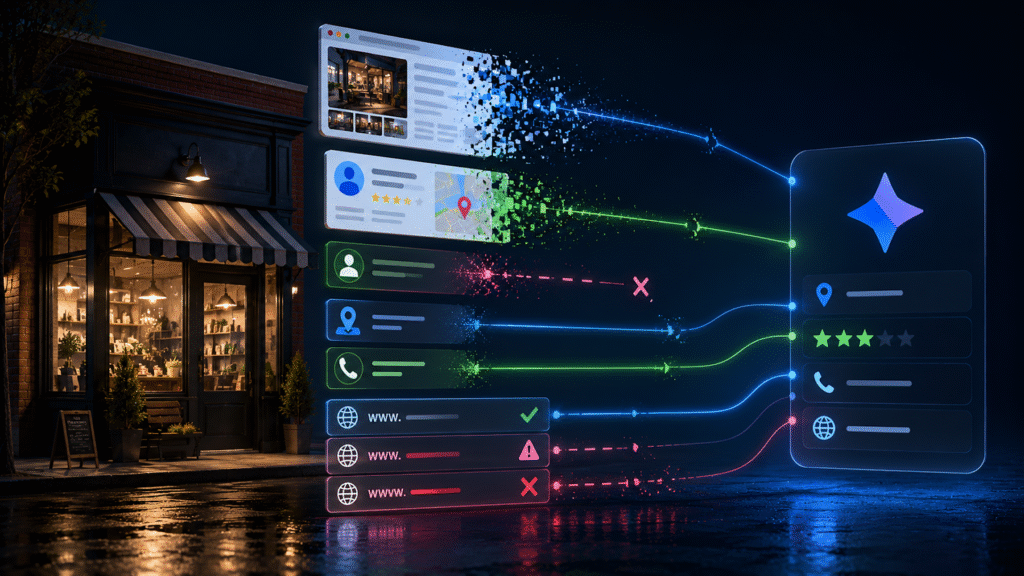

There’s a gap between what a business is in the real world and how an AI search system can verify it. I call this the “identity leak.”
Businesses may not be struggling, but they may be invisible to AI systems, which decide what sites get recommended and surfaced to searchers. This can affect a business’s future growth.
I ran an audit of dozens of verified businesses on Prince Edward Island (PEI), Canada, spanning multiple industries, to see how they showed up in AI search results.
The audit found that the average PEI business was leaking 84% of its identity to AI systems, and 17% of the sample had no AI-retrievable digital presence at all.
Here’s what the identity leak is, why it happens, and how to close it.
What is the 84% identity leak?
An AI search retrieval system doesn’t browse a website the way a person does. It looks for specific, verifiable facts: who runs a certain business, where it is, what it does, whether the people behind it are real, etc.
When it can’t find these, it guesses, using whatever fragments it can piece together from the web. Or it’ll simply leave the business out of an answer entirely.
The gap between what’s true about a business and what an AI can confirm about it is the identity leak.
Here are some examples of how businesses appeared in the audit I conducted.
Trust signals exist, but AI can’t surface them
This is the most common and most fixable version of the leak. Twenty-two of the 71 businesses in the sample had named, identifiable leadership somewhere on their own site.
In several cases, that information lived on an “Our Team,” “Our History,” or “Our Family” subpage that a routine pass of the homepage by an AI missed.
The information is there, it’s just not where the verification needs to be.
Be the brand AI recommends.
See where your brand appears in AI search, where competitors are winning, and what it takes to become the answer AI recommends.
See your AI visibility
Site exists, but nothing is readable by an AI
Several businesses in the sample had professionally built, real, modern-looking websites that returned zero extractable text to a direct fetch.
They were built entirely in client-side JavaScript with no static fallback. One of these was a software company whose own tagline promised “intuitive enterprise and AI systems.” Its homepage was unreadable to the very system it claimed to be built for.
Business is real, but the domain is dead
One well-known cheesemaker’s domain is now for sale by a domain reseller, and a salt producer’s domain returned nothing. The brand now survives only as a product line sold through another website. Neither business showed up where a crawler was looking.
Identity is split across the web
One chocolatier circulated under three different domain variants across directories, and a…
Source link
Disclaimer
We strive to uphold the highest ethical standards in all of our reporting and coverage. We blogs.grocliq.com want to be transparent with our readers about any potential conflicts of interest that may arise in our work. It’s possible that some of the investors we feature may have connections to other businesses, including competitors or companies we write about. However, we want to assure our readers that this will not have any impact on the integrity or impartiality of our reporting. We are committed to delivering accurate, unbiased news and information to our audience, and we will continue to uphold our ethics and principles in all of our work. Thank you for your trust and support.
Website Upgradation is going on for any glitch kindly connect at [email protected]