

Let’s talk about an agentic future. As task-completing agents move from concept to adoption, their impact on how we discover and transact online will be significant. Websites won’t vanish, but in many cases, their utility will shrink as agents become the new intermediary layer between people and answers. Domains will still exist, but their value as discovery assets is likely to erode. Building and maintaining a site will increasingly mean structuring it for agents to retrieve from, not just for people to browse, and the idea of domains appreciating as scarce assets will feel less connected to how discovery actually happens.
The growth trajectory for AI agents is already clear in the data. Grand View Research valued the global AI agents market at USD 5.40 billion in 2024, with forecasts reaching USD 50.31 billion by 2030 at an annual growth rate of about 45.8%. Regionally, the Asia-Pacific market was USD 1.30 billion in 2024 and is projected to expand to USD 14.15 billion by 2030, with China alone expected to grow from USD 402.6 million to USD 3.98 billion over the same period. Europe is following a similar path, climbing from USD 1.32 billion in 2024 to USD 11.49 billion by 2030. Longer-term, Precedence Research projects the global agentic AI market will rise from USD 7.55 billion in 2025 to nearly USD 199.05 billion by 2034, a compound growth rate of 43.84%. These forecasts from multiple regions show a consistent global pattern: adoption is accelerating everywhere, and the shift toward agentic systems is not theoretical; it is underway. These figures are about task-completing agents, not casual chat use.
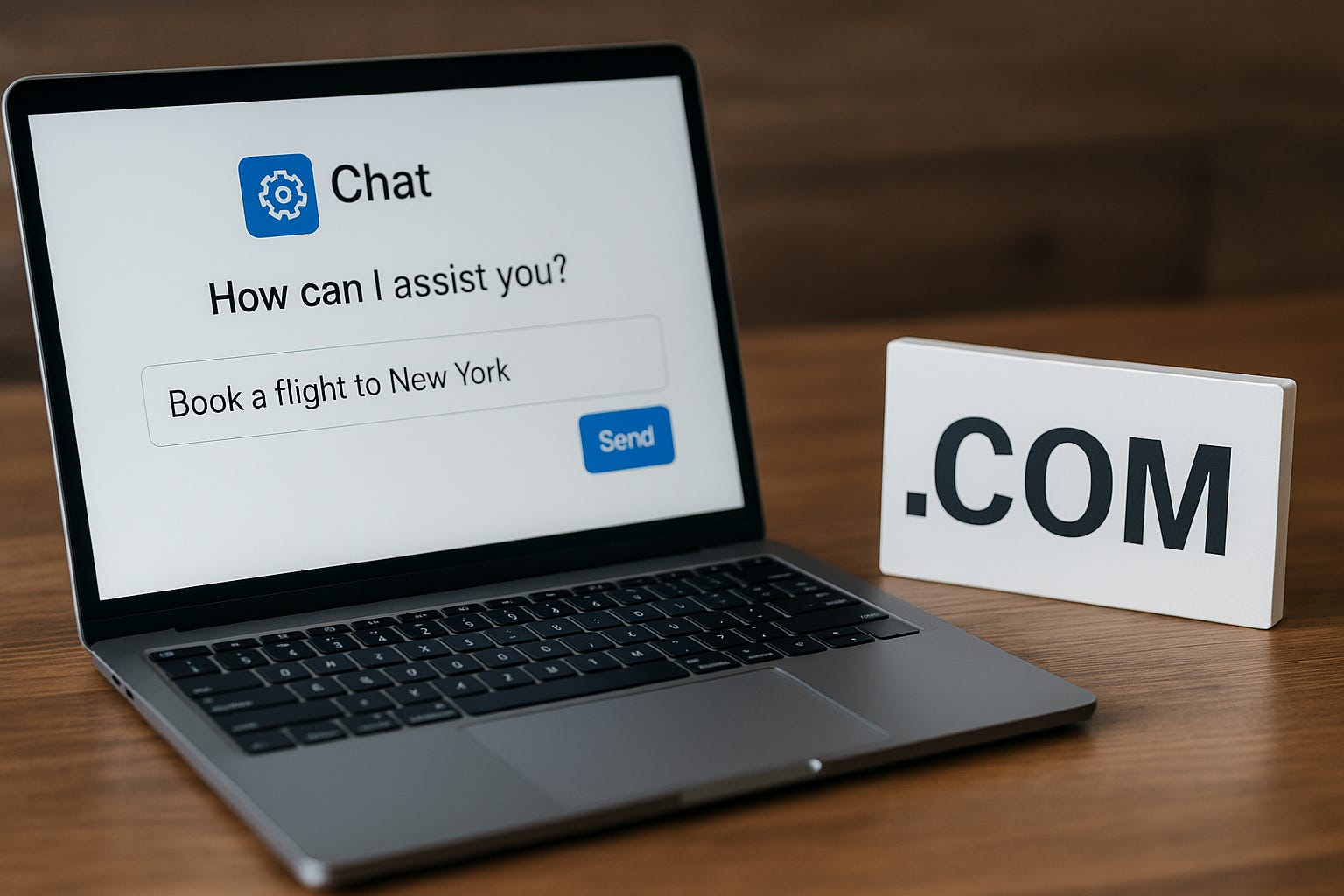 Image Credit: Duane Forrester
Do We Still Need Websites In An Agentic World?
It’s easy to forget how limited the internet felt in the 1990s. On AOL, you didn’t browse the web the way we think of it today. You navigated keywords. One word dropped you into chat rooms, news channels, or branded content. The open web was technically out there, but for most people, America Online WAS the internet.
That closed-garden model eventually gave way to the open web. Domains became navigation anchors. Owning a clean .com or a trusted extension like .org or .gov signaled legitimacy. Websites evolved into the front doors of digital identity, where brand credibility and consumer trust were built. Search rankings reinforced this. An exact-match domain once boosted visibility, and later the concept of “domain authority” helped indicate who showed up at the top of search results. For nearly three decades, websites have been the central hub of digital discovery and transactions.
But we may be circling back. Only this time, the keyword is no longer “AOL Keyword: Pizza Hut.” It’s your natural-language intent: “Book me a flight,” “Order flowers,” “Find me a dentist nearby.” And instead of AOL, the gatekeepers are LLMs and agentic systems.
From Navigation To Answers
The rise of agentic systems collapses the journey we’ve been…
Source link
Disclaimer
We strive to uphold the highest ethical standards in all of our reporting and coverage. We blogs.grocliq.com want to be transparent with our readers about any potential conflicts of interest that may arise in our work. It’s possible that some of the investors we feature may have connections to other businesses, including competitors or companies we write about. However, we want to assure our readers that this will not have any impact on the integrity or impartiality of our reporting. We are committed to delivering accurate, unbiased news and information to our audience, and we will continue to uphold our ethics and principles in all of our work. Thank you for your trust and support.
Website Upgradation is going on for any glitch kindly connect at [email protected]