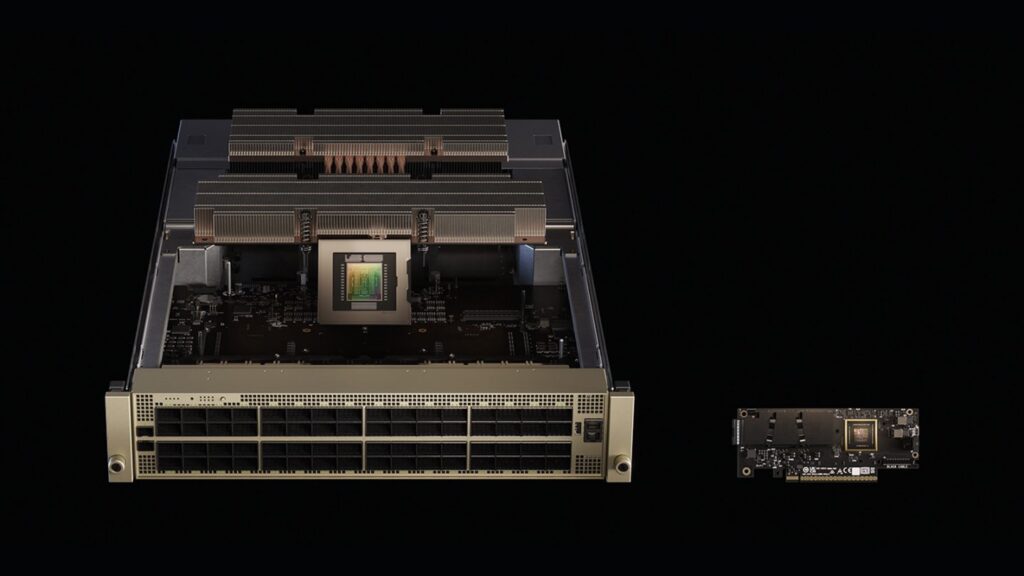

Meta and Oracle are upgrading their AI data centres with NVIDIA’s Spectrum-X Ethernet networking switches — technology built to handle the growing demands of large-scale AI systems. Both companies are adopting Spectrum-X as part of an open networking framework designed to improve AI training efficiency and accelerate deployment across massive compute clusters.
Jensen Huang, NVIDIA’s founder and CEO, said trillion-parameter models are transforming data centres into “giga-scale AI factories,” adding that Spectrum-X acts as the “nervous system” connecting millions of GPUs to train the largest models ever built.
Oracle plans to use Spectrum-X Ethernet with its Vera Rubin architecture to build large-scale AI factories. Mahesh Thiagarajan, Oracle Cloud Infrastructure’s executive vice president, said the new setup will allow the company to connect millions of GPUs more efficiently, helping customers train and deploy new AI models faster.
Meta, meanwhile, is expanding its AI infrastructure by integrating Spectrum-X Ethernet switches into the Facebook Open Switching System (FBOSS), its in-house platform for managing network switches at scale. According to Gaya Nagarajan, Meta’s vice president of networking engineering, the company’s next-generation network must be open and efficient to support ever-larger AI models and deliver services to billions of users.
Building flexible AI systems
According to Joe DeLaere, who leads NVIDIA’s Accelerated Computing Solution Portfolio for Data Centre, flexibility is key as data centres grow more complex. He explained that NVIDIA’s MGX system offers a modular, building-block design that lets partners combine different CPUs, GPUs, storage, and networking components as needed.
The system also promotes interoperability, allowing organisations to use the same design across multiple generations of hardware. “It offers flexibility, faster time to market, and future readiness,” DeLaere said to the media.
As AI models become larger, power efficiency has become a central challenge for data centres. DeLaere said NVIDIA is working “from chip to grid” to improve energy use and scalability, collaborating closely with power and cooling vendors to maximise performance per watt.
One example is the shift to 800-volt DC power delivery, which reduces heat loss and improves efficiency. The company is also introducing power-smoothing technology to reduce spikes on the electrical grid — an approach that can cut maximum power needs by up to 30 per cent, allowing more compute capacity within the same footprint.
Scaling up, out, and across
NVIDIA’s MGX system also plays a role in how data centres are scaled. Gilad Shainer, the company’s senior vice president of networking, told the media that MGX racks host both compute and switching components, supporting NVLink for scale-up connectivity and Spectrum-X Ethernet for scale-out growth.
He added that MGX can connect multiple AI data centres together as a unified…
Source link
Disclaimer
We strive to uphold the highest ethical standards in all of our reporting and coverage. We blogs.grocliq.com want to be transparent with our readers about any potential conflicts of interest that may arise in our work. It’s possible that some of the investors we feature may have connections to other businesses, including competitors or companies we write about. However, we want to assure our readers that this will not have any impact on the integrity or impartiality of our reporting. We are committed to delivering accurate, unbiased news and information to our audience, and we will continue to uphold our ethics and principles in all of our work. Thank you for your trust and support.
Website Upgradation is going on for any glitch kindly connect at [email protected]