

Marketers today spend their time on keyword research to uncover opportunities, closing content gaps, making sure pages are crawlable, and aligning content with E-E-A-T principles. Those things still matter. But in a world where generative AI increasingly mediates information, they are not enough.
The difference now is retrieval. It doesn’t matter how polished or authoritative your content looks to a human if the machine never pulls it into the answer set. Retrieval isn’t just about whether your page exists or whether it’s technically optimized. It’s about how machines interpret the meaning inside your words.
That brings us to two factors most people don’t think about much, but which are quickly becoming essential: semantic density and semantic overlap. They’re closely related, often confused, but in practice, they drive very different outcomes in GenAI retrieval. Understanding them, and learning how to balance them, may help shape the future of content optimization. Think of them as part of the new on-page optimization layer.
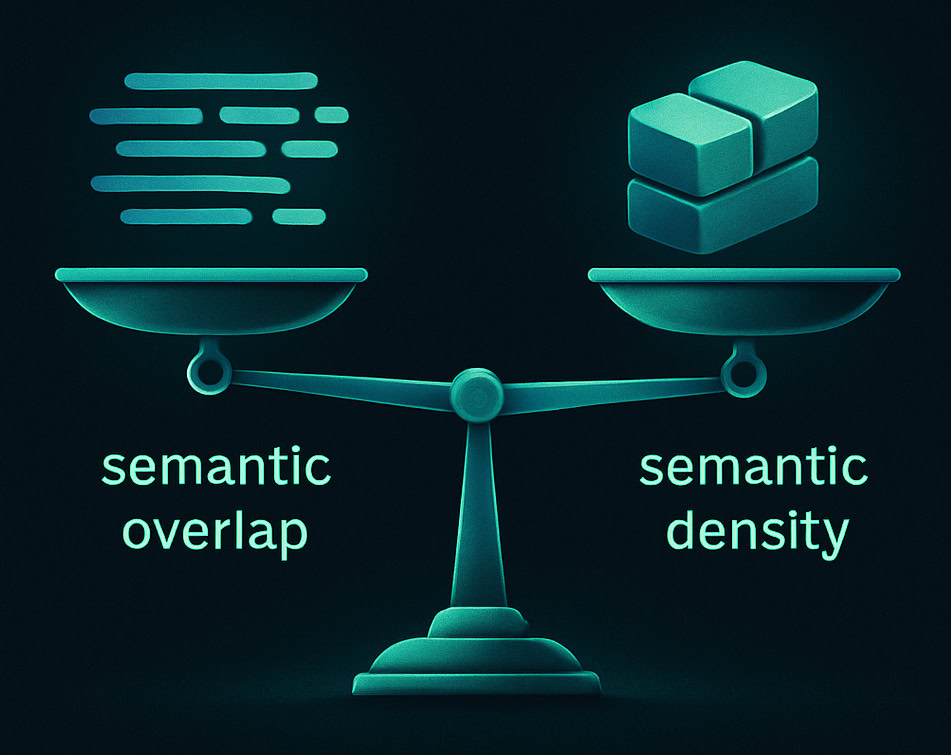 Image Credit:: Duane Forrester
Semantic density is about meaning per token. A dense block of text communicates maximum information in the fewest possible words. Think of a crisp definition in a glossary or a tightly written executive summary. Humans tend to like dense content because it signals authority, saves time, and feels efficient.
Semantic overlap is different. Overlap measures how well your content aligns with a model’s latent representation of a query. Retrieval engines don’t read like humans. They encode meaning into vectors and compare similarities. If your chunk of content shares many of the same signals as the query embedding, it gets retrieved. If it doesn’t, it stays invisible, no matter how elegant the prose.
This concept is already formalized in natural language processing (NLP) evaluation. One of the most widely used measures is BERTScore (https://arxiv.org/abs/1904.09675), introduced by researchers in 2020. It compares the embeddings of two texts, such as a query and a response, and produces a similarity score that reflects semantic overlap. BERTScore is not a Google SEO tool. It’s an open-source metric rooted in the BERT model family, originally developed by Google Research, and has become a standard way to evaluate alignment in natural language processing.
Now, here’s where things split. Humans reward density. Machines reward overlap. A dense sentence may be admired by readers but skipped by the machine if it doesn’t overlap with the query vector. A longer passage that repeats synonyms, rephrases questions, and surfaces related entities may look redundant to people, but it aligns more strongly with the query and wins retrieval.
In the keyword era of SEO, density and overlap were blurred together under optimization practices. Writing naturally while including enough variations of a keyword often achieved both. In GenAI retrieval, the two diverge. Optimizing for one…
Source link
Disclaimer
We strive to uphold the highest ethical standards in all of our reporting and coverage. We blogs.grocliq.com want to be transparent with our readers about any potential conflicts of interest that may arise in our work. It’s possible that some of the investors we feature may have connections to other businesses, including competitors or companies we write about. However, we want to assure our readers that this will not have any impact on the integrity or impartiality of our reporting. We are committed to delivering accurate, unbiased news and information to our audience, and we will continue to uphold our ethics and principles in all of our work. Thank you for your trust and support.
Website Upgradation is going on for any glitch kindly connect at [email protected]