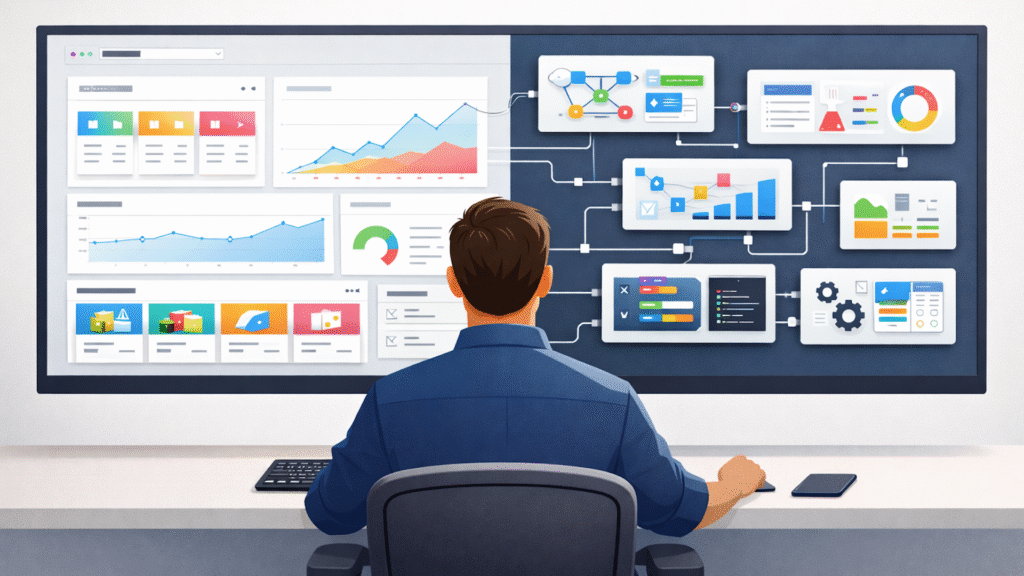

Automation has been reshaping PPC account management for years, from rules, scripts, and API-driven workflows inside Google Ads.
Most marketers are already comfortable with automated bidding, data-driven optimization, and other AI-powered enhancements.
The next shift goes further. Two developments in particular are changing how PPC campaigns are managed and optimized: AI agents and vibe coding.
Together, they point to a more autonomous way of working, where execution increasingly moves to AI – while marketers focus on strategy, systems, and creative direction.
This shift unlocks new levels of efficiency and flexibility, but it also changes what effective PPC management looks like.
Agentic AI: Google Ads has its own agentic AI integrated
Google released its Agentic Ads Advisor in November 2025.
The tool uses the latest Gemini models to help advertisers surface insights and improve campaign performance.
Google describes Ads Advisor as:
- “[Y]our AI partner that helps you proactively manage campaigns directly within Google Ads. It helps you understand your business context and simplifies your work by learning from your interactions to improve campaign results.”
The goal is to help advertisers analyze and optimize campaigns more efficiently.
But it raises an important question: what should an agentic AI tool actually do?
An agentic AI should function as an autonomous agent.
It should surface information when needed, but it should also be able to operate independently when appropriate.
That includes identifying opportunities to improve campaign setup, assets and ad copy, search terms, and other inputs.
More importantly, it should be capable of implementing certain changes, not just recommending them.
That is where agentic AI needs to go. As Jyll Saskin Gales noted after testing the tool, Google’s Ads Advisor is useful in places but not yet capable of acting autonomously.
How agentic AI can be used in PPC workflows
AI agents are meant to be autonomous.
They should be able to make decisions without constant human input, actively managing, adjusting, and optimizing campaigns in real time.
If an agentic AI only provides advice or reporting, much of its potential is lost.
In practical terms, agentic AI can handle bidding strategies, ad placements, audience targeting, and creative testing.
Instead of simply adjusting bids or budgets, it can make decisions on the fly, optimizing campaigns based on live performance data, seasonality, competitive activity, and user behavior trends.
This represents a fundamental shift in how PPC accounts are managed.
As agentic AI takes on more operational work, PPC professionals can spend more time on strategic decision-making.
Over time, it is likely that many advertisers will rely on the same algorithms, campaign types, and AI agents.
When that happens, competitive advantage will depend less on tooling and…
Source link
Disclaimer
We strive to uphold the highest ethical standards in all of our reporting and coverage. We blogs.grocliq.com want to be transparent with our readers about any potential conflicts of interest that may arise in our work. It’s possible that some of the investors we feature may have connections to other businesses, including competitors or companies we write about. However, we want to assure our readers that this will not have any impact on the integrity or impartiality of our reporting. We are committed to delivering accurate, unbiased news and information to our audience, and we will continue to uphold our ethics and principles in all of our work. Thank you for your trust and support.
Website Upgradation is going on for any glitch kindly connect at [email protected]