
Throughout 2025, SEO professionals reported the same story to leadership: organic traffic was down, clicks were declining, and attribution no longer made sense.
AI-driven search experiences, zero-click results, and platform-level answers widened the gap between discovery and measurable visits, making it harder than ever to accurately report on organic performance.
For many organizations, this showed up as double-digit, year-over-year declines in reported organic traffic and leads.
The C-suite asked the obvious questions: Why are clicks down? Why does organic traffic look 25% lower than last year? Is SEO actually hurting the business?
The problem wasn’t that organic search stopped working. It was that the way most organizations measure it no longer reflects how discovery happens today.
Why last-touch attribution is the wrong model for 2026
We have not been accurately measuring organic search.
Many organizations still rely on last-touch attribution, which measures the end of the customer journey – not the start.
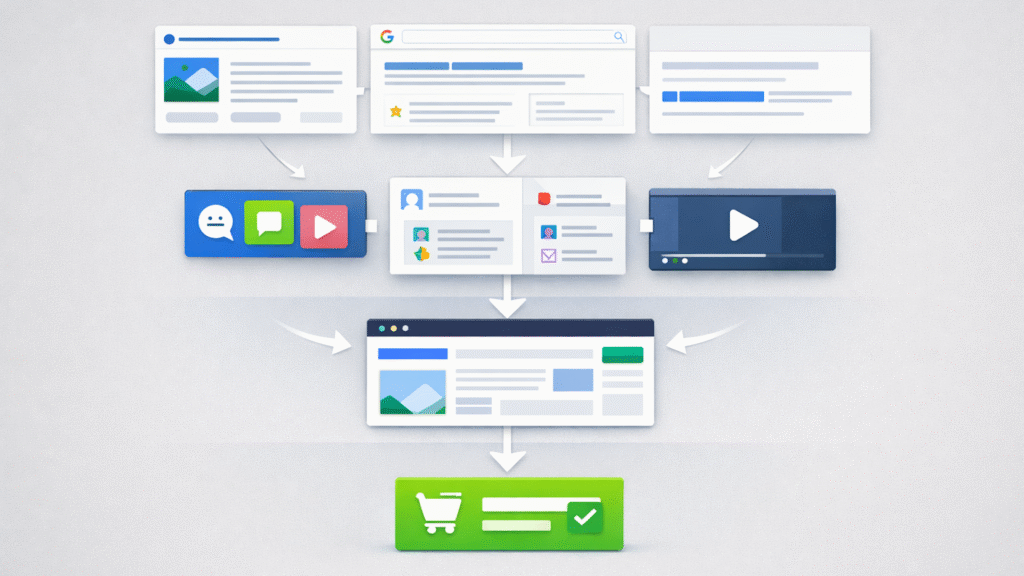
Our attribution models are linear – Search → Click → Convert – but user behavior is not.
Most traditional attribution models assume discovery leads to a measurable click.
Today, AI-driven SERPs are challenging that assumption and widening the gap between influence and revenue credit.
Last-touch attribution rewards the finish line – not the start of the race.
Which is to say, last-touch attribution collapses in an AI-first, zero-click world, especially for organic search. AI-driven search is accelerating attribution blind spots.
Our measurement is not broken. It’s outdated and doesn’t tell us the holistic story.
As an industry, we need to rethink our KPIs and how to measure success.
We need to tell the full data story throughout the entire customer journey, from the very top and down to the click and conversion.
Dig deeper: Marketing attribution guide: Models, tools, & best practices
So why is last touch a problem?
Last-touch attribution only measures the end of the customer journey.
Because of that, it misses all interactions that occur before the conversion, across channels like Google, Reddit, YouTube, AI Overviews, AI Mode, ChatGPT, Instagram, email, paid SERP listings, and more.
Most users of Google Analytics or Adobe Analytics rely on last-touch attribution when setting up their analytics.
This works as a baseline, but to tell the full story, you also need to understand where your first touches are coming from.
This is especially true as traditional organic traffic – click-throughs from the SERPs – continues to decline with the rise of AI Overviews and AI Mode.
Do you have the data you need for first-touch attribution?
Many organizations have data that is messy, siloed, and replete with quality and integrity issues.
Take a look at yours and ask yourself whether you can easily find the answer to these questions:
- How are my…
Source link
Disclaimer
We strive to uphold the highest ethical standards in all of our reporting and coverage. We blogs.grocliq.com want to be transparent with our readers about any potential conflicts of interest that may arise in our work. It’s possible that some of the investors we feature may have connections to other businesses, including competitors or companies we write about. However, we want to assure our readers that this will not have any impact on the integrity or impartiality of our reporting. We are committed to delivering accurate, unbiased news and information to our audience, and we will continue to uphold our ethics and principles in all of our work. Thank you for your trust and support.
Website Upgradation is going on for any glitch kindly connect at [email protected]