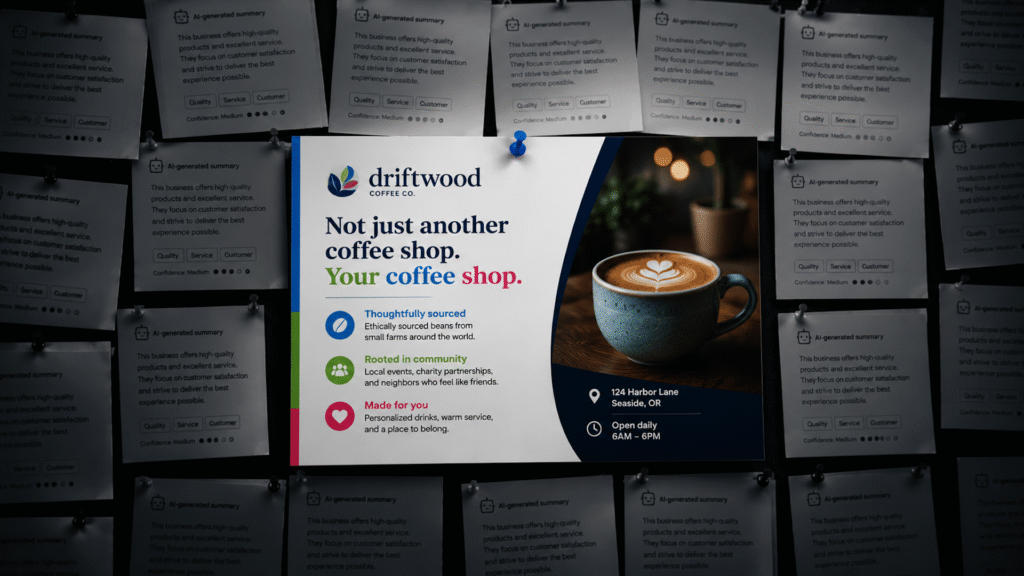

Most businesses sound interchangeable online, and AI search is making that impossible to ignore. When ChatGPT, Google AI Overviews, or other AI systems summarize your business, they build that understanding from your website, profiles, reviews, and content. If all of it sounds like everyone else in your category, the machine’s summary will too.
This is why AI visibility is becoming a positioning problem as much as a technical one.
Businesses that stand out in AI search are not necessarily the ones with the biggest budgets or the most aggressive tactics. They’re the businesses that clearly communicate who they serve, what they do differently, and why customers should care. Everything else — content, ads, SEO, PPC, schema, and optimization — only amplifies that underlying message.
Why businesses default to tactics instead of positioning
Sun Tzu said it first, and nobody has improved on it since:
- “Strategy without tactics is the slowest route to victory. Tactics without strategy is the noise before defeat.”
He was talking about warfare, but he might as well have been sitting in on a digital marketing meeting, watching a business owner ask their agency to “do something with the SEO” while their homepage still describes how they deliver exceptional results with great service.
There is a pattern here: something changes, whether it’s a Google update, a dip in traffic, or the dawning realization that AI is changing how people research and buy things. This creates an instinct to act. Immediately. Update the keywords, try a new ad format, and post more on LinkedIn. Be busy, busy, busy. Do something because at least action feels like progress.
This isn’t just a marketing folly. This is evolutionary behavior that is hardwired.
Daniel Kahneman spent a career documenting this. His framework from “Thinking, Fast and Slow” describes two cognitive systems: System 1, which is fast, automatic, and emotional, and System 2, which is slow, deliberate, and analytical.
The uncomfortable finding? System 1, basically heuristics, runs the show roughly 95% of the time. We’re not the rational strategists we imagine ourselves to be. We’re pattern-matching, reflex-driven creatures who take comfort in movement and action.
Psychologists call the specific reflex that drives all this tactical overactivity “action bias” — the largely unconscious urge to act in the face of uncertainty, even when a more considered approach would serve us better.
Think of a goalkeeper who dives left or right on a penalty kick, even though the data shows they’d save more by standing still. The diving feels more engaged, more committed, more in control. Standing still feels like giving up — even when it’s the smarter play.
Business owners do this constantly. They change their Google Ads targeting every week because the waiting feels unbearable. They add another service to their homepage because it feels more…
Source link
Disclaimer
We strive to uphold the highest ethical standards in all of our reporting and coverage. We blogs.grocliq.com want to be transparent with our readers about any potential conflicts of interest that may arise in our work. It’s possible that some of the investors we feature may have connections to other businesses, including competitors or companies we write about. However, we want to assure our readers that this will not have any impact on the integrity or impartiality of our reporting. We are committed to delivering accurate, unbiased news and information to our audience, and we will continue to uphold our ethics and principles in all of our work. Thank you for your trust and support.
Website Upgradation is going on for any glitch kindly connect at [email protected]