
We are navigating the “search everywhere” revolution – a disruptive shift driven by generative AI and large language models (LLMs) that is reshaping the relationship between brands, consumers, and search engines.
For the last two decades, the digital economy ran on a simple exchange: content for clicks.
With the rise of zero-click experiences, AI Overviews, and assistant-led research, that exchange is breaking down.
AI now synthesizes answers directly on the SERP, often satisfying intent without a visit to a website.
Platforms such as Gemini and ChatGPT are fundamentally changing how information is discovered.
For enterprises, visibility increasingly depends on whether content is recognized as authoritative by both search engines and AI systems.
That shift introduces a new goal – to become the source that AI cites.
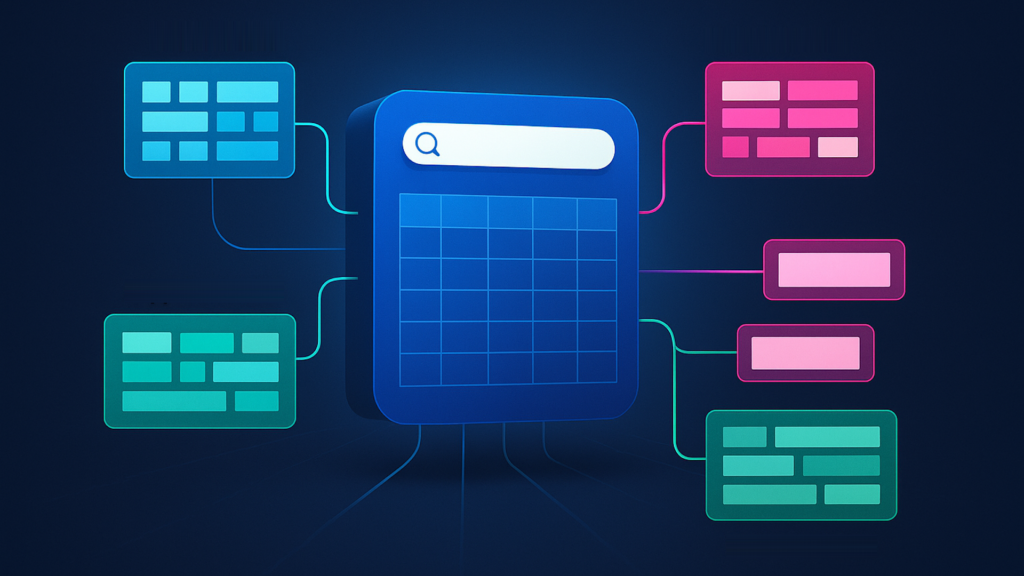
A content knowledge graph is essential to achieving that goal.
By leveraging structured data and entity SEO, brands can build a semantic data layer that enables AI to accurately interpret their entities and relationships, ensuring continued discoverability in this evolving economy.
This article explores:
- The difference between traditional search and AI search, including the concept of comprehension budget.
- Why schema and entity optimization are foundational to discovery in AI search.
- The content knowledge graph and the importance of organizational entity lineage.
- The enterprise entity optimization playbook and deployment checklist.
- The role of schema in the agentic web.
- How connected journeys improve customer discovery and total cost of ownership.
The fundamental difference between traditional and AI search
To become a source that AI cites, it’s essential to understand how traditional search differs from AI-driven search.
Traditional search functioned much like software as a service.
It was deterministic, following fixed, rule-based logic and producing the same output for the same input every time.
AI search is probabilistic.
It generates responses based on patterns and likelihoods, which means results can vary from one query to the next.
Even with multimodal content, AI converts text, images, and audio into numerical representations that capture meaning and relationships rather than exact matches.
For AI to cite your content, you need a strong data layer combined with context engineering – structuring and optimizing information so AI can interpret it as reliable and trustworthy for a given query.
As AI systems rely increasingly on large-scale inference rather than keyword-driven indexing, a new reality has emerged: the cost of comprehension.
Each time an AI model interprets text, resolves ambiguity, or infers relationships between entities, it consumes GPU cycles, increasing already significant computing costs.
A comprehension budget is the finite allocation of compute that determines whether content is worth the effort for…
Source link
Disclaimer
We strive to uphold the highest ethical standards in all of our reporting and coverage. We blogs.grocliq.com want to be transparent with our readers about any potential conflicts of interest that may arise in our work. It’s possible that some of the investors we feature may have connections to other businesses, including competitors or companies we write about. However, we want to assure our readers that this will not have any impact on the integrity or impartiality of our reporting. We are committed to delivering accurate, unbiased news and information to our audience, and we will continue to uphold our ethics and principles in all of our work. Thank you for your trust and support.
Website Upgradation is going on for any glitch kindly connect at [email protected]