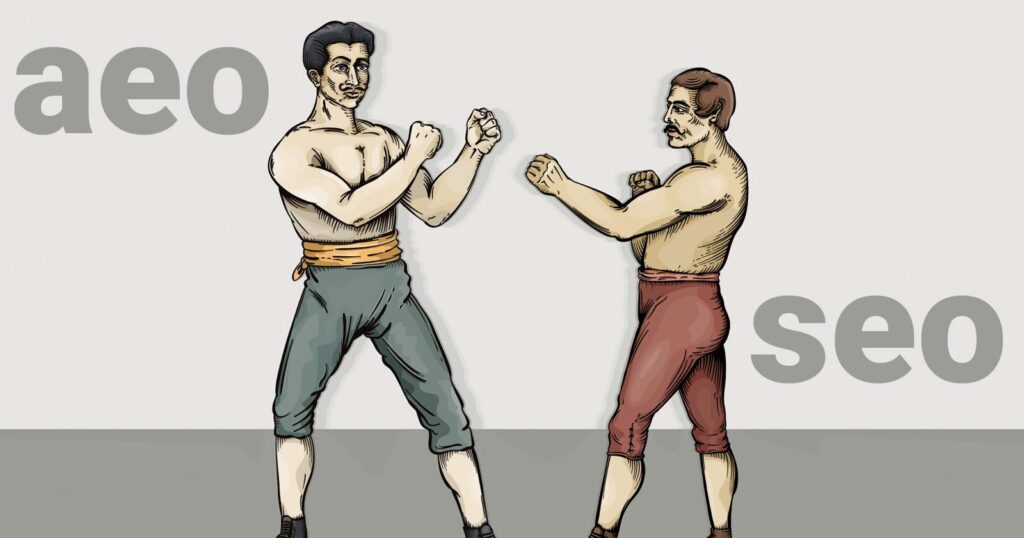

The debate about AEO/GEO centers on whether it’s a subset of SEO, a standalone discipline, or just standard SEO. Deciding on where to plant a flag is difficult because every argument makes a solid case. There’s no doubt that change is underway and it may be time find where all the competing ideas intersect and work from there.
The Case Against AEO/GEO
Many SEOs argue that AEO/GEO doesn’t differentiate itself enough to justify being anything other than a subset of SEO, sharing computers in the same office.
Harpreet Singh Chatha (X profile) of Harps Digital recently tweeted about AEO / GEO myths to leave behind in 2025.
Some of what he listed:
- “LLMs.txt
- Paying a GEO expert to do “chunk optimization.” Chunking content is just making your content readable.
- Thinking AEO / GEO have nothing in common with SEO. Ask your favourite GEO expert for 25 things that are unique to AI search and don’t overlap with SEO. They will block you.
- Saying SEO is dead. “
The legendary Greg Boser (LinkedIn profile), one of the original SEOs since 1996 tweeted this:
“At the end of the day, the core foundation of what we do always has been and always will be about understanding how humans use technology to gain knowledge.
We don’t need to come up with a bunch of new acronyms to continue to do what we do. All that needs to happen is we all agree to change the “E” in SEO from “Engine” to “Experience”.
Then everyone can stop wasting time writing all the ridiculous SEO/GEO/AEO posts, and get back to work.”
Inability To Articulate AEO/GEO
What contributes to the perception that AEO/GEO is not a real thing is that many proponents of AEO/GEO fail to differentiate it from standard SEO. We’ve all seen it where someone tweets their new tactic and the SEO peanut gallery chimes in, nah, that’s SEO.
Back in October Microsoft published a blog post about optimizing content for for AI where they asserted:
“While there’s no secret strategy for being selected by AI systems, success starts with content that is fresh, authoritative, structured, and semantically clear.”
The post goes on to affirm the importance of SEO fundamentals such as “Crawlability, metadata, internal linking, and backlinks” but then states that these are just starting points. Microsoft points out that AI search provides answers, not ranked list of pages. That’s correct and it changes a lot.
Microsoft says that now it’s about which pieces of content are being ranked:
“In AI search, ranking still happens, but it’s less about ordering entire pages and more about which pieces of content earn a place in the final answer.”
That kind of echoes what Jesse Dwyer of Perplexity AI recently said about AI Search and SEO:
“As for the index technology, the biggest difference in AI search right now comes down to whole-document vs. “sub-document” processing.
…The AI-first approach is known as “sub-document processing.” Instead of indexing whole pages, the engine…
Source link
Disclaimer
We strive to uphold the highest ethical standards in all of our reporting and coverage. We blogs.grocliq.com want to be transparent with our readers about any potential conflicts of interest that may arise in our work. It’s possible that some of the investors we feature may have connections to other businesses, including competitors or companies we write about. However, we want to assure our readers that this will not have any impact on the integrity or impartiality of our reporting. We are committed to delivering accurate, unbiased news and information to our audience, and we will continue to uphold our ethics and principles in all of our work. Thank you for your trust and support.
Website Upgradation is going on for any glitch kindly connect at [email protected]