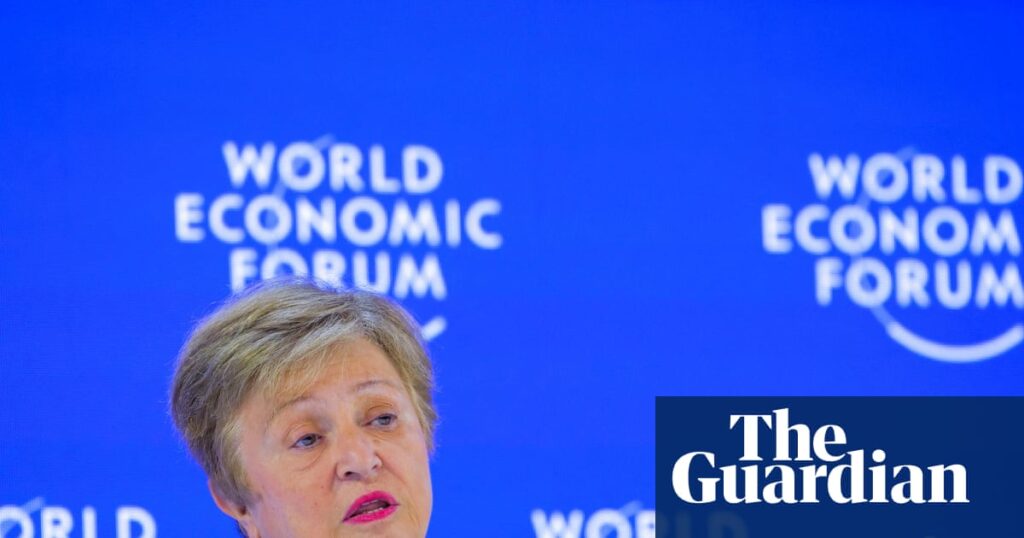

Artificial intelligence will be a “tsunami hitting the labour market”, with young people worst affected, the head of the International Monetary Fund warned the World Economic Forum on Friday.
Kristalina Georgieva told delegates in Davos that the IMF’s own research suggested there would be a big transformation of demand for skills, as the technology becomes increasingly widespread.
“We expect over the next years, in advanced economies, 60% of jobs to be affected by AI, either enhanced or eliminated or transformed – 40% globally,” she said. “This is like a tsunami hitting the labour market.”
She suggested that in advanced economies, one in 10 jobs had already been “enhanced” by AI, tending to boost these workers’ pay, with knock-on benefits for the local economy.
By contrast, Georgieva warned that AI would wipe out many roles traditionally taken up by younger workers. “Tasks that are eliminated are usually what entry-level jobs do at present, so young people searching for jobs find it harder to get to a good placement.”
Meanwhile people whose jobs were not directly changed by artificial intelligence risked being squeezed, she said, with their pay potentially falling without a productivity boost from AI.
“So the middle class, inevitably, is going to be affected,” Georgieva predicted.
She said her greatest fear was that AI was insufficiently regulated. “This is moving so fast, and yet we don’t know how to make it safe. We don’t know how to make it inclusive. Wake up, AI is for real, and it is transforming our world faster than we are getting ahead of it,” she said.
Much of the debate at the annual meeting of the business and political elite in the Swiss ski resort this week has been hijacked by Donald Trump’s on-off tariff threats over the future of Greenland.
But many delegates were also keen to highlight the risks and benefits of AI. Christy Hoffman, general secretary of the UNI global union, told the Guardian: “It’s just a basic premise that the point of AI, on the business side, is to increase productivity, therefore lower costs – which will be cutting jobs.”
“I think it’s time to come to terms with that disruption – and how to manage that disruption,” she said, calling for the productivity benefits to be distributed fairly across the economy.
“We want to share in the gains. We’re not going to stop AI, nor do we want to even try – but we don’t want it to just roll over us.” She called on employers to discuss the role of AI tools with workers and their representatives before introducing them.
Earlier in the week at Davos, the Microsoft chief executive, Satya Nadella, warned that AI could lose its “social permission” to compete for resources such as energy, for example, if it failed to generate benefits beyond a few powerful tech firms – such as the rapid development of effective new drugs.
Georgieva was speaking on a panel alongside the president of the European Central Bank, Christine…
Source link
Disclaimer
We strive to uphold the highest ethical standards in all of our reporting and coverage. We blogs.grocliq.com want to be transparent with our readers about any potential conflicts of interest that may arise in our work. It’s possible that some of the investors we feature may have connections to other businesses, including competitors or companies we write about. However, we want to assure our readers that this will not have any impact on the integrity or impartiality of our reporting. We are committed to delivering accurate, unbiased news and information to our audience, and we will continue to uphold our ethics and principles in all of our work. Thank you for your trust and support.
Website Upgradation is going on for any glitch kindly connect at [email protected]