

You’ve probably seen some version of these three claims:
- Quote-led headlines outperform plain declarative ones by nearly 29%.
- Question headlines underperform both, sometimes by 24%.
- Format drives the result: Rewrite a statement as a quote, or add that magic word, and you should expect a real lift.
We tested all three against 1,674,518 English editorial articles and 1,690,295 French articles from the 1492.vision Discover corpus (November 2025 to May 2026): about 3.4 million editorial articles with at least one capture across our fleet.
They share a deeper flaw than any of their numbers.
All three treat headline format as a cause — a lever you pull to gain visibility. But the data shows, layer after layer, that a format’s measured effect is almost entirely a proxy for something else: which publisher used it, for which audience, and on which Discover surface.
The headline is a symptom of those choices, not an independent driver.
The clearest demonstration is Simpson’s paradox. Once you see it, you find it throughout the dataset.
A note on what we measure
Our metric isn’t clicks from Discover; no third party has that data. It’s hits per article: how often an article appears across the 1492.vision fleet we observe, a proxy for visibility.
The corpus is limited to editorial articles. YouTube and X are excluded because their headlines follow different conventions. We’ll return to both at the end—they sharpen the point more than anything else.
A word on why the volume matters: the entire argument depends on being able to slice 3.4 million articles by publisher, Discover surface, topic, and language while still retaining enough data in each segment for meaningful comparisons. That’s the difference between a number and an insight — and between a real format effect and a statistical mirage.
The number is real, at the wrong altitude
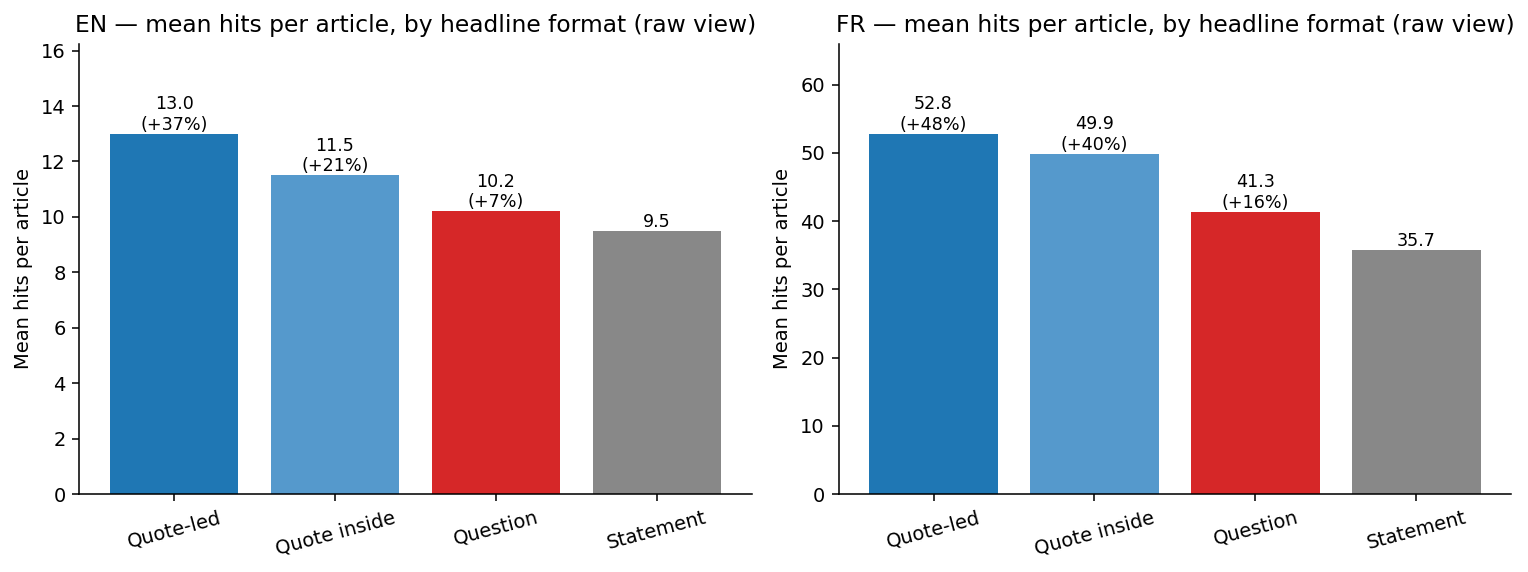
Pool all publishers together, and a clean gradient emerges: quote-led headlines at the top, statements at the bottom.
| Lang | Format | Articles | Mean hits | Median | vs statement |
|---|---|---|---|---|---|
| EN | Quote-led | 38,044 | 13.0 | 4 | +37% |
| EN | Quote inside | 75,463 | 11.5 | 4 | +21% |
| EN | Question | 53,081 | 10.2 | 4 | +7% |
| EN | Statement | 1,674,518 | 9.5 | 3 | baseline |
| FR | Quote-led | 179,472 | 52.8 | 13 | +48% |
| FR | Quote inside | 223,052 | 49.9 | 12 | +40% |
| FR | Question | 103,117 | 41.3 | 11 | +16% |
| FR | Statement | 1,690,295 | 35.7 | 9 | baseline |
The commonly cited +29% is conservative for pure editorial articles: quote-led headlines show a +37% lift in English and +48% in French. Questions, far from underperforming, also outperform statements (+7% EN, +16% FR).
At this level of aggregation, claim 1 looks understated and claim 2 looks plainly wrong.
This is the level of aggregation where most headline advice is born. Hold onto that +37% figure — the rest of this piece is about what it’s actually measuring.
Hidden variable 1: which publisher
The aggregate can’t answer a crucial objection on its own: the publishers that use quotes…
Source link
Disclaimer
We strive to uphold the highest ethical standards in all of our reporting and coverage. We blogs.grocliq.com want to be transparent with our readers about any potential conflicts of interest that may arise in our work. It’s possible that some of the investors we feature may have connections to other businesses, including competitors or companies we write about. However, we want to assure our readers that this will not have any impact on the integrity or impartiality of our reporting. We are committed to delivering accurate, unbiased news and information to our audience, and we will continue to uphold our ethics and principles in all of our work. Thank you for your trust and support.
Website Upgradation is going on for any glitch kindly connect at [email protected]