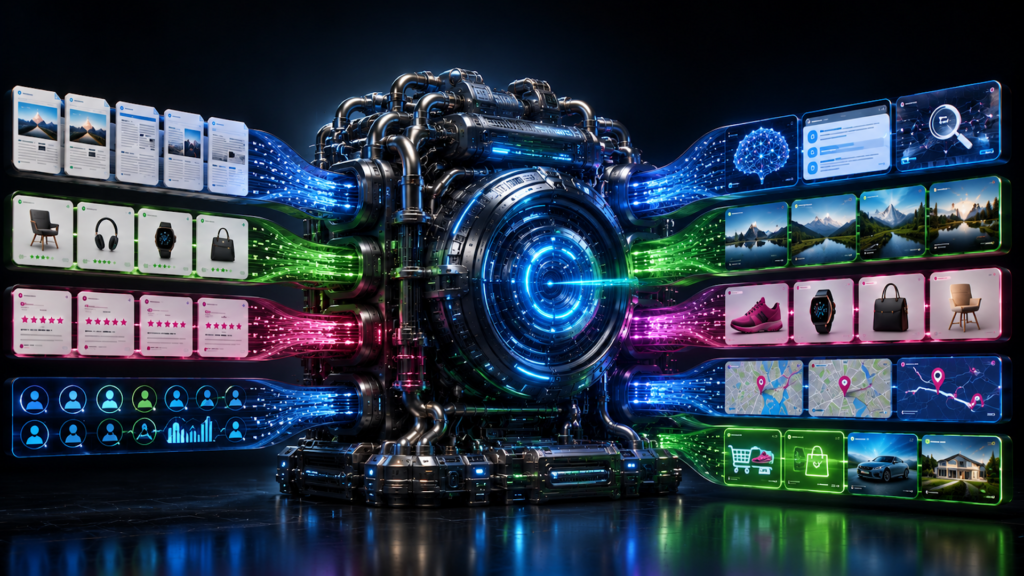

The idea that AI is killing advertising misses the bigger shift. As AI expands across search, assistants, productivity tools, and transactions, advertising is moving with it.
Ad density may be changing within AI experiences, but advertising opportunities are expanding across a growing number of surfaces.
At the same time, paid and organic are becoming harder to separate. The same AI systems increasingly power ad campaigns, search experiences, and brand visibility across Google’s ecosystem.
That changes how brands should think about visibility.
Paid and organic are no longer separate channels competing for the same click. They are increasingly different ways of influencing the same AI systems, which means the signals shaping organic visibility may also affect paid performance.
The old model: Paid and organic on one finite SERP
Google’s SERP was a finite surface: 10 organic blue links, a few ad slots, and a knowledge panel on the right. The user landed, scanned, and clicked.
Paid and organic teams operated on separate budgets, separate tools, and separate quarterly reports, and rarely talked to each other because manual Google Ads kept the paid specialist busy full time. Titles, descriptions, bids, and campaign structure were all chosen by hand and required constant attention, which is why the organic team had no part in any of it.
DSA changed that for me. It read my organic pages to decide which ads to run, who to show them to, when, at what bid, and what title to use. I controlled the descriptions. The engine decided everything else, and it did it better than I would’ve done manually because it was reading the same signals the organic side was already optimizing for.
When someone at Google in Singapore explained how PMax worked, I thought, “That’s exactly what I was doing.”
PMax took the DSA logic and extended it across every Google surface simultaneously: Search, YouTube, Gmail, Display, Maps, and Shopping, all in one campaign, with the engine making every placement decision from your assets and audience signals.
AI Max brought the same intelligence into Search campaigns, specifically, with Gemini underneath instead of rules. PMax and AI Max run on the same Gemini brain: one focused on Search, the other spread across every surface, applying the same funnel logic to different contexts with different signal layers on top.
And if Gemini’s understanding of your brand is thin, it fills those decisions with whatever it thinks will work, which isn’t necessarily your brand narrative, and you have no direct way to override it. You train it, or you lose control of your own ads.
Be the brand AI recommends.
See where your brand appears in AI search, where competitors are winning, and what it takes to become the answer AI recommends.
See your AI visibility
The new model: Gemini sits inside every…
Source link
Disclaimer
We strive to uphold the highest ethical standards in all of our reporting and coverage. We blogs.grocliq.com want to be transparent with our readers about any potential conflicts of interest that may arise in our work. It’s possible that some of the investors we feature may have connections to other businesses, including competitors or companies we write about. However, we want to assure our readers that this will not have any impact on the integrity or impartiality of our reporting. We are committed to delivering accurate, unbiased news and information to our audience, and we will continue to uphold our ethics and principles in all of our work. Thank you for your trust and support.
Website Upgradation is going on for any glitch kindly connect at [email protected]