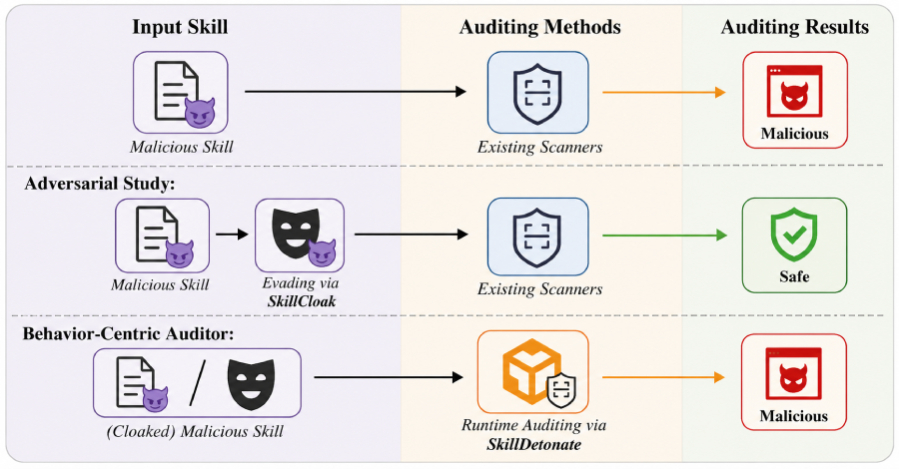


Scanners meant to catch malicious add-on “skills” for AI coding agents can be fooled by a few simple changes that leave the malware working, according to a new study from researchers at the Hong Kong University of Science and Technology.
Their strongest trick slipped past every scanner tested more than 90% of the time, and the same team built a runtime checker that catches most of the disguised skills the scanners miss.
Skills are small packages, usually a Markdown instruction file plus a few scripts, that agents such as Claude Code, OpenAI Codex, and OpenClaw load to pick up a new capability. Because a skill is just a bundle of files, the same one can run across different agents. And it runs with the agent’s own access: your files, your terminal, your saved passwords.
A bad one can steal credentials, copy source code, or install a backdoor. Most of what a public marketplace lists is uploaded by strangers with little vetting.
The main defense so far has been the skill scanner, which reads a skill’s files before you install it and blocks anything that looks dangerous. The paper, titled “Cloak and Detonate,” tests whether that actually holds up. It does not. Beating scanners isn’t new, though.
The Hacker News has covered researchers pushing a fake skill past every scanner it faced, which by the firm’s own count reached tens of thousands of agents. What this paper adds is a way to do it systematically, at scale, and a defense that still works when it does.
How the disguised skills get through
The researchers’ tool, SKILLCLOAK, rewrites a malicious skill to look clean while behaving exactly the same. It works two ways.
The lighter one rewrites the give-away bytes a scanner keys on, using the paper’s own operators: swap a character for a look-alike from another alphabet, or split a flagged command across a newline, so the scanner’s pattern no longer matches but the command still runs.
The heavier one, self-extracting packing, moves the whole payload into a directory the scanner skips, like .git/, behind a harmless-looking decoder that rebuilds the skill only when the agent runs it. Scanners skip such directories to save time and cut false alarms, which is exactly the blind spot the trick exploits.

Across eight scanners and 1,613 real malicious skills pulled from ClawHub, a public marketplace, the packing trick got past each of the eight more than 90% of the time, and past most of them more than 99%.
The lighter rewriting cleared more than 80% on most scanners and 96% on one. And the disguise costs the attacker almost nothing: on Claude Code and OpenAI Codex, the cloaked skills worked just as well as the originals.
Watching what a skill does, not how it looks
Since appearance can be faked, the researchers propose checking behavior instead, in a tool they call SKILLDETONATE. It runs the skill in a sandbox and watches what it does at the operating-system level: what it reads, what it writes, where it sends data.
Two ideas make it…
Source link
Disclaimer
We strive to uphold the highest ethical standards in all of our reporting and coverage. We blogs.grocliq.com want to be transparent with our readers about any potential conflicts of interest that may arise in our work. It’s possible that some of the investors we feature may have connections to other businesses, including competitors or companies we write about. However, we want to assure our readers that this will not have any impact on the integrity or impartiality of our reporting. We are committed to delivering accurate, unbiased news and information to our audience, and we will continue to uphold our ethics and principles in all of our work. Thank you for your trust and support.
Website Upgradation is going on for any glitch kindly connect at [email protected]