
The lines between paid media, PR, and SEO are officially gone.
Investing in baked-in YouTube sponsorships, native UGC, and third-party review incentives is the modern equivalent of buying a high-DA backlink. When you fund these channels, you’re investing in information sources that shape how AI systems understand and recommend your brand.
A recent social media screenshot brought that shift into focus. A B2B brand was offering a $250 Amazon voucher to anyone who wrote a review on G2.
To a growth marketer, that’s a standard user acquisition tactic. As an SEO, I saw something different: a direct investment in the semantic infrastructure AI systems use to evaluate brands.
The evolution of the authority signal
To understand why a $250 G2 voucher or a paid YouTube sponsorship is an SEO strategy, we have to look at how LLMs define authority.
Authority used to be transactional and mathematical. You built or bought hyperlinks.
When I moved from link building into digital PR and influencer marketing, I realized Google was getting smarter. We needed unlinked brand mentions, high-tier media coverage, and contextual relevance. We were optimizing for Google’s Knowledge Graph.
Today, retrieval-augmented generation (RAG) systems and LLMs don’t just count links or parse knowledge graphs. They look for semantic consensus across the web.

When an AI engine like Perplexity or ChatGPT answers a user query, it crawls the data ecosystems it trusts most for that specific topic. For software, that’s G2 and Reddit. For consumer products, it’s TikTok transcripts, YouTube, and forums.
When you pay $250 for a G2 review, you’re buying a dense, text-based data point that an LLM can use to determine your brand’s sentiment, use cases, and vector positioning. You’re strengthening the signals AI systems use to recommend your brand.
Be the brand AI recommends.
See where your brand appears in AI search, where competitors are winning, and what it takes to become the answer AI recommends.
See your AI visibility
This reality shatters the traditional “church and state” separation of paid media and SEO.
Historically, paid ads were temporary. You turned off the budget, the traffic stopped, and SEO was left to clean up the long-term mess. If you run a dynamic programmatic ad on YouTube or a banner ad on a website, that model still holds true. LLM web scrapers ignore dynamic ad placements entirely.
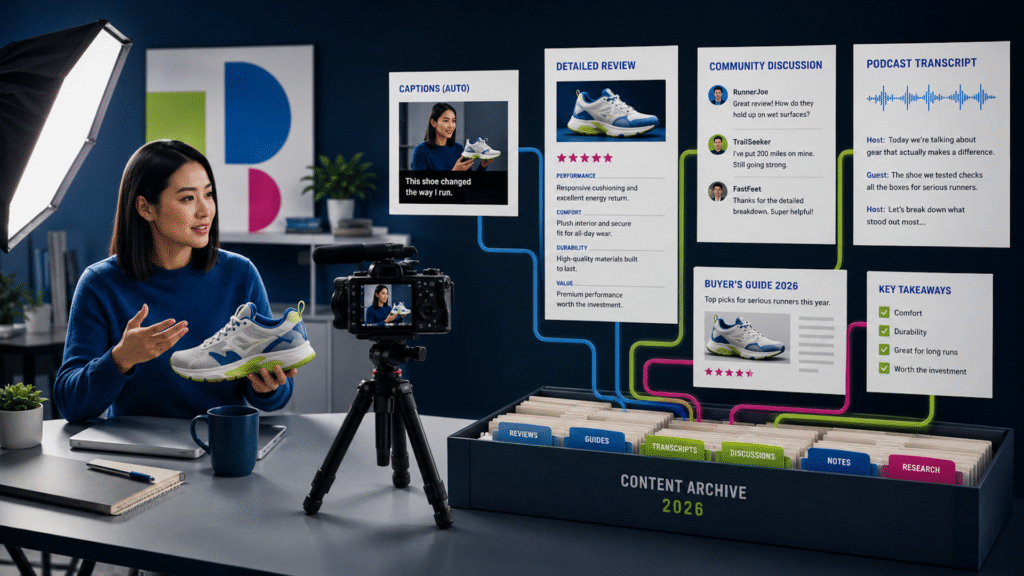
Here’s what happens when you invest in baked-in influencer sponsorships, native user-generated content (UGC), or podcast reads:
- The hardcoded transcript: When a YouTuber reads a native sponsor segment (“I use Brand X to manage my business taxes…”), that segment is baked into the video file. YouTube automatically transcribes it.
- LLM ingestion: When an LLM crawls the web or a multimodal AI watches the video,…
Source link
Disclaimer
We strive to uphold the highest ethical standards in all of our reporting and coverage. We blogs.grocliq.com want to be transparent with our readers about any potential conflicts of interest that may arise in our work. It’s possible that some of the investors we feature may have connections to other businesses, including competitors or companies we write about. However, we want to assure our readers that this will not have any impact on the integrity or impartiality of our reporting. We are committed to delivering accurate, unbiased news and information to our audience, and we will continue to uphold our ethics and principles in all of our work. Thank you for your trust and support.
Website Upgradation is going on for any glitch kindly connect at [email protected]