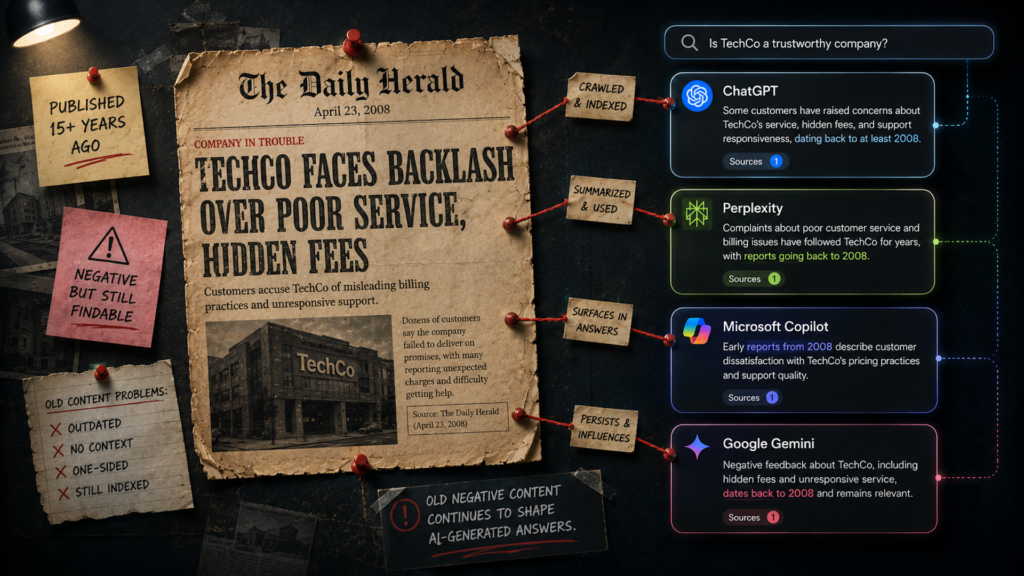

Ten years ago, a negative piece of online content primarily affected search rankings.
Today, that same article can influence across Google’s AI Overviews and other AI search experiences. It can be summarized, cited, and redistributed, making it more influential and longer-lasting than it ever should be.
As a result, outdated stories can resurface long after they disappear from traditional search results. That gives older content renewed visibility and makes reputation management far more difficult.
When old articles resurface
I recently saw this happen with a client who owns a grocery chain in the Midwest that has grown successfully for more than two decades.
In the mid-2010s, one location received negative press over a customer service issue. The problem was resolved shortly afterward, and the article gradually faded from public attention.
Years later, AI Overviews gave the story new visibility. Seemingly overnight, the article became a recurring source in AI-generated answers about the business.
A single, outdated news story began shaping how AI systems described a company whose reputation had long since moved on.
Be the brand AI recommends.
See where your brand appears in AI search, where competitors are winning, and what it takes to become the answer AI recommends.
See your AI visibility
Why AI keeps resurfacing old stories
AI search engines don’t just retrieve information. They generate answers by relying on published sources they consider reliable.
That changes the role of negative news articles. Even if an article no longer ranks prominently in traditional search results, it can remain an authoritative source for AI-generated answers.
Media coverage often carries strong authority signals. If a negative article receives attention, citations, or discussion, AI systems may continue treating it as a reliable source long after the underlying issue is resolved.
That’s why a single article can influence how AI describes a person, company, or brand years after it was published. The article doesn’t need to dominate search rankings anymore. It only needs to remain a trusted source.
Five or 10 years ago, handling negative content involved suppression. We aimed to bury the negative content by publishing fresher, more positive, and more accurate content, optimizing a client’s online profiles and social media, and building microsites to strengthen its reputation.
That approach matters less today. AI systems readily access and cite original negative sources, even when those sources no longer rank prominently in search results.
Dig deeper: How negative information spreads from Wikipedia into AI search
How to adapt your reputation strategy
AI has changed online reputation management, but you still have options. Here are the approaches we’ve found most effective.
Diversify your…
Source link
Disclaimer
We strive to uphold the highest ethical standards in all of our reporting and coverage. We blogs.grocliq.com want to be transparent with our readers about any potential conflicts of interest that may arise in our work. It’s possible that some of the investors we feature may have connections to other businesses, including competitors or companies we write about. However, we want to assure our readers that this will not have any impact on the integrity or impartiality of our reporting. We are committed to delivering accurate, unbiased news and information to our audience, and we will continue to uphold our ethics and principles in all of our work. Thank you for your trust and support.
Website Upgradation is going on for any glitch kindly connect at [email protected]