
Every page you publish is vulnerable to traffic decay. The question is whether you catch it when it’s down 15% or 80%, and whether you fix the right thing when you do.
Most teams catch it late, then reach for the same tool every time: refresh it. Update the date, add a few hundred words, republish. Sometimes that works. Often it does nothing. Occasionally, it makes the page worse.
That’s because falling clicks are only a symptom. A page can lose traffic for at least four reasons, and each requires a different fix.
The content decay playbook most of us inherited treats every decline as the same problem with the same cure. In 2026, that playbook is missing a cause, and it’s one many teams still overlook.
Here’s how to identify the type of decay you’re dealing with using data you already have, and what to do about it.
Content decay isn’t one problem
Content decay is a sustained loss of organic clicks and impressions over time. One-week fluctuations don’t qualify. It isn’t a new idea. For years, SEOs have explained it in terms of three root causes: a competitor improved, search intent shifted, or demand for the topic declined.
That model is still mostly right. It’s just incomplete because it predates AI Overviews.
In 2026, fewer than one in three Google searches sends a click to the open web. About 68% end without a click, up from roughly 60% two years ago. On queries where an AI Overview appears, the top organic result loses around 58% of its clicks. AI Overviews also appear far more often on informational queries than on commercial ones, which is exactly the kind of query most blogs are built to win.
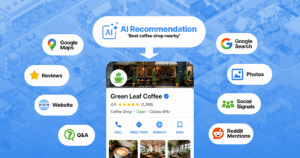
AI Overviews introduced a new way for pages to lose traffic. Rankings can hold steady, demand can stay the same, and clicks can still disappear.
That’s why content decay is no longer one problem. It’s four.
Be the brand customers find first.
Track, grow, and measure your visibility across Google, AI search, social, local, and every channel that influences buying decisions.
Start your free trial
The four types of content decay
Each type of content decay leaves a different fingerprint in your data. Here’s what to look for.
1. Ranking decay
Clicks down, impressions down, average position worse. A competitor overtook you, the content went stale, you lost links, or two of your own pages are cannibalizing each other. This is the classic case, and the only one a content refresh reliably fixes.
2. Zero-click capture (the new one)
Clicks down, but impressions are flat or up, and position is stable or better. You’re still ranking, often higher than before, and still losing clicks.
That’s the fingerprint of an AI Overview, a featured snippet, or another SERP feature answering the query right on the results page. A routine refresh won’t bring the clicks back because you didn’t…
Source link
Disclaimer
We strive to uphold the highest ethical standards in all of our reporting and coverage. We blogs.grocliq.com want to be transparent with our readers about any potential conflicts of interest that may arise in our work. It’s possible that some of the investors we feature may have connections to other businesses, including competitors or companies we write about. However, we want to assure our readers that this will not have any impact on the integrity or impartiality of our reporting. We are committed to delivering accurate, unbiased news and information to our audience, and we will continue to uphold our ethics and principles in all of our work. Thank you for your trust and support.
Website Upgradation is going on for any glitch kindly connect at [email protected]