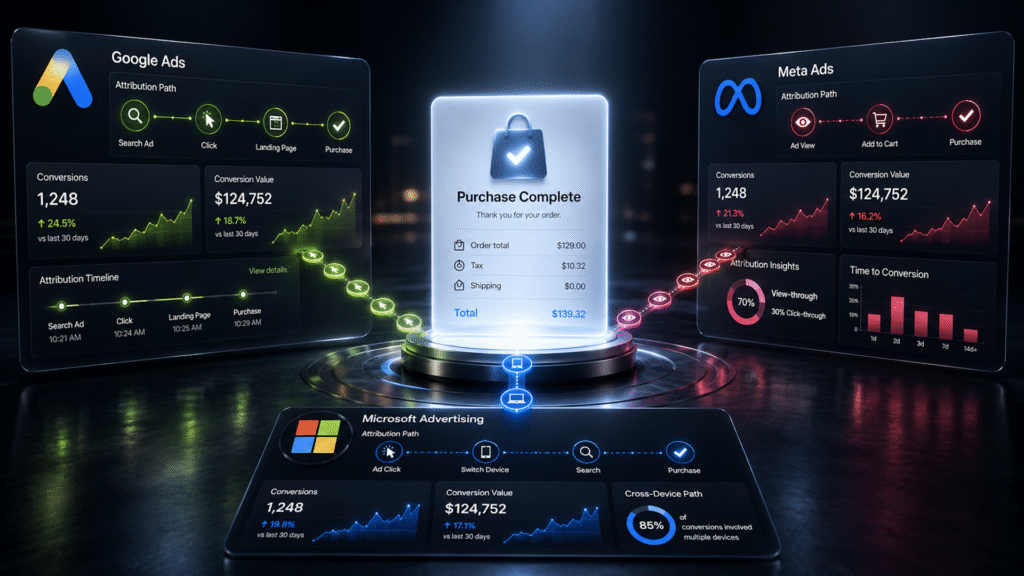

If you run paid media, you already know the feeling. Google Ads says you drove 400 conversions last month. Meta claims another 250. Microsoft adds 60 more.
Add them up, and you’ve apparently sold to 710 people. But your finance team’s report says only 480 sales hit the bank.
So who’s lying?
Nobody.
Most people assume the numbers are wrong.
Ad platforms almost always report more conversions than your business records. Platforms report higher numbers because they count conversions differently. Once you understand those counting methods, the apparent contradiction becomes much easier to interpret and use.
Start with the incentive
Here’s the uncomfortable truth that explains almost everything else: it’s in a platform’s commercial interest to report more conversions.
The more conversions a platform shows you, the better it looks. The better it looks, the more you believe it’s working. The more you believe it’s working, the more you spend. That’s the business model. Always remember what makes the platform money.
This is rational economics. Given a choice between counting conservatively and counting generously, every platform has a structural reason to count generously, and they all do.
Every click they win is a customer you lose.
See where competitors are investing, which keywords drive their results, and how to capture more of the market.
See who’s stealing your traffic
It’s counting, not lying
Here’s the reframe that keeps this from turning into another “the platforms are lying to you” rant.
The number of real conversions is fixed. There are only so many real conversions in a given period, no matter how many get reported across Google, Meta, and Microsoft combined. Three platforms can each claim the same sale, and frequently do, but the customer still bought only once.
Focus less on reconciling every number and more on understanding how each platform counts conversions. Don’t get too caught up chasing a perfect, unified number across every platform.
Understand the differences, work with what you’ve got, and accept that “good enough to move the dial” is usually the right standard for the business.
Dig deeper: Why attribution and impact are no longer the same thing in PPC
The structural reasons the numbers don’t line up
If you want to explain the gaps to a CFO, or to yourself, these are the concrete reasons platforms diverge from each other and from your own systems.
Attribution windows
This is one of the biggest. Meta defaults to a seven-day click window (plus a one-day view). Google Ads with data-driven attribution looks back up to 90 days.
Before you change anything else, those two platforms are already counting different conversions simply because they’re looking at different time frames.
What counts as an ‘engagement’
Platforms…
Source link
Disclaimer
We strive to uphold the highest ethical standards in all of our reporting and coverage. We blogs.grocliq.com want to be transparent with our readers about any potential conflicts of interest that may arise in our work. It’s possible that some of the investors we feature may have connections to other businesses, including competitors or companies we write about. However, we want to assure our readers that this will not have any impact on the integrity or impartiality of our reporting. We are committed to delivering accurate, unbiased news and information to our audience, and we will continue to uphold our ethics and principles in all of our work. Thank you for your trust and support.
Website Upgradation is going on for any glitch kindly connect at [email protected]